How to Sell More Concert Tickets With Meta Ads in 2026
Every empty seat at a concert is money left on the table. In today's crowded digital landscape, simply posting about your event and hoping fans show up is no longer a viable strategy. The artists, promoters, and venues consistently selling out shows have one thing in common: they have mastered the art of paid social advertising.
If you are serious about learning how to sell more tickets for a concert using Meta ads with the best strategy available right now, you are in the right place. Meta's advertising ecosystem, spanning Facebook and Instagram, remains one of the most powerful tools for reaching music fans with precision targeting, compelling creative, and conversion-focused campaigns that actually drive ticket sales.
In this guide, you will learn exactly how to structure your Meta ad campaigns for maximum impact, which audience targeting methods deliver the strongest results, and how to optimize your ads as event day approaches. Whether you are promoting a local club show or a large-scale venue event, these proven tactics will help you fill seats faster and spend your ad budget more efficiently.
Why Most Concert Meta Ad Campaigns Fail Before You Touch Creative
Consider two comparable independent bands, each handed a
This matters because most artists and their teams approach Meta ads as a creative problem. They iterate on video hooks, test different copy angles, and debate whether to show the artist or the venue. All of that work is downstream of three structural decisions that, if wrong, guarantee poor results regardless of how compelling the ad looks.
The Three Failure Modes That Kill Concert Campaigns Early
The first failure mode is selecting the wrong campaign objective. Running a Traffic or Reach objective when the goal is ticket sales tells Meta's algorithm to optimize for clicks and impressions, not purchases. The platform will dutifully deliver exactly what you asked for while your ticket inventory sits untouched. The Conversions objective, by contrast, instructs Meta to find people statistically likely to complete a purchase transaction.
The second failure mode is broken or incomplete conversion tracking. Without a properly firing purchase event on the ticketing confirmation page, Meta receives no signal about what actually happened after the click. The algorithm cannot optimize toward an outcome it cannot see.
The third failure mode is ignoring geography before any other targeting layer. A concert is a local event. Reaching the right demographic in the wrong city generates zero ticket sales at any budget level. Geographic anchoring to the show's market is the foundational constraint that must be applied before interest, behavior, or lookalike targeting enters the picture. Leap Event Tech's breakdown of Meta ads for events reinforces this principle: the platform's reach only becomes an asset when it is constrained to people who can physically attend.
The Tension That Runs Through Every Concert Campaign
Here is the problem that unites all three failure modes: ad spend is always visible, but ticket sales attributed to that spend are almost always invisible. Meta's dashboard will show you reach, link clicks, and landing page views with perfect clarity. What it will not show you, unless your conversion infrastructure is correctly built, is whether any of those landing page views became purchased tickets.
This gap was surfaced with striking clarity in a public comment on a viral music marketing case study reel, where a viewer asked directly: "How do you know if the landing page views converted to actual sales?" It is the right question, and most concert campaigns never answer it. The rest of this guide is built around closing that gap, so that every dollar you put into Meta ads generates a signal you can actually act on.
The Non-Negotiables Before You Spend a Dollar
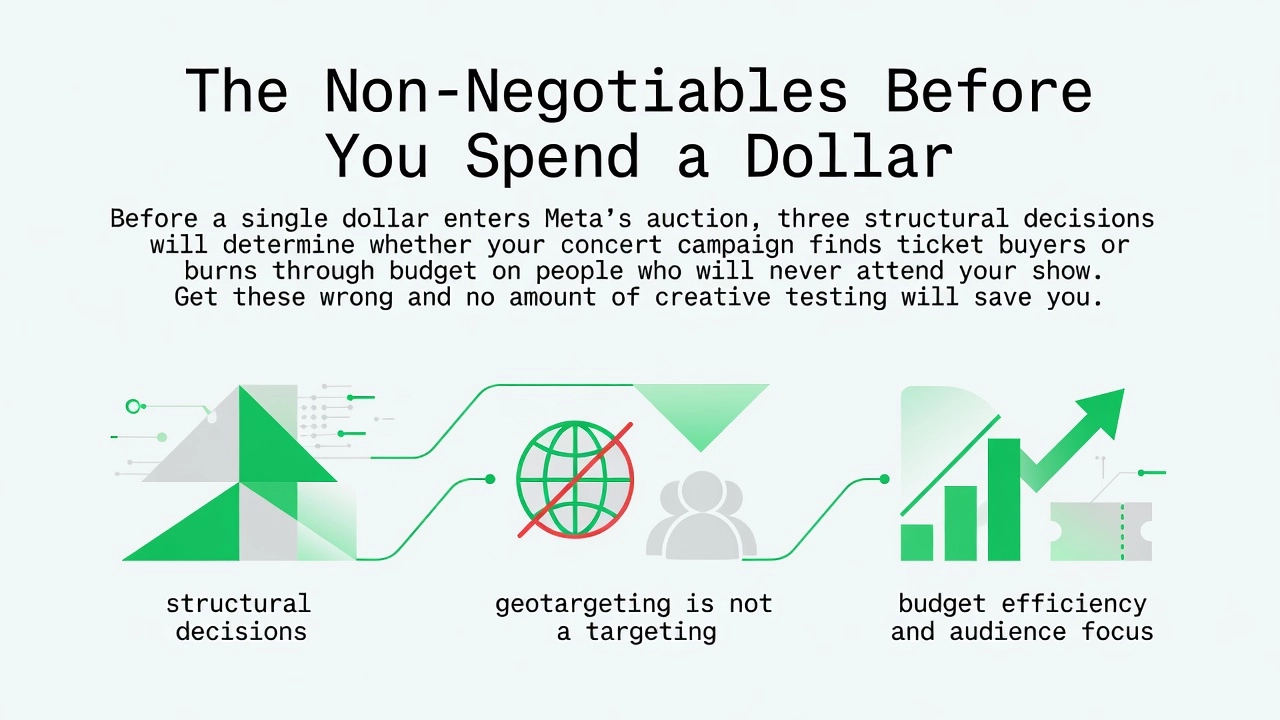
Before a single dollar enters Meta's auction, three structural decisions will determine whether your concert campaign finds ticket buyers or burns through budget on people who will never attend your show. Get these wrong and no amount of creative testing will save you.
Lock Geography Before Everything Else
Geotargeting is not a targeting refinement. It is the first constraint applied to any concert campaign, set before interests, before demographics, before you upload a single creative asset. A click from someone 600 miles from your venue costs exactly the same as a click from someone two streets away. Only one of those clicks has any chance of becoming a ticket sale. Concert ads running without a geographic anchor are not underperforming; they are structurally broken from the moment they go live.
The radius you choose should reflect the realistic travel range of your audience. For a 300-capacity club show in a mid-sized city, a 25 to 40-mile radius around the venue is a reasonable starting point. For a larger regional draw, expand to 60 to 75 miles. The point is to make this decision deliberately, before Meta starts spending on your behalf.
Select the Conversions Objective, Not Traffic
Campaign objective selection is not a cosmetic preference inside Ads Manager. It directly instructs Meta's algorithm on what kind of person to find. A Traffic campaign optimizes for clicks. A Reach campaign optimizes for impressions. Neither tells Meta that your goal is a completed purchase transaction. When you choose the Conversions objective, you are directing Meta's machine learning to identify users in your target geography who are statistically most likely to complete a checkout, not just tap a link and bounce. Without this signal, you are paying to surface browsers and scrollers. As documented in one widely circulated case study, $500 in Facebook ads generated $40,000 in concert ticket sales, a result that is structurally impossible without the Conversions objective and proper tracking infrastructure working together.
Why the Pixel Alone Fails in 2026
The Meta Pixel works by firing a tracking event inside the user's browser when someone completes a purchase. That mechanism has a serious and worsening problem: iOS 14+ privacy changes mean a significant share of users have opted out of browser-level tracking. When that happens, the Pixel cannot fire, the purchase event is never reported to Meta, and the algorithm optimizes on an incomplete data set. It does not know those buyers existed.
The solution is the Conversions API (CAPI), and understanding it does not require a technical background. Rather than relying on the buyer's browser to send the signal, CAPI passes conversion events directly from the server to Meta. It bypasses the user's browser, their device settings, and any adblocker running on their machine entirely. Meta receives the purchase confirmation regardless of how the buyer has configured their privacy settings. The practical result is that Meta's algorithm builds a more accurate picture of who is actually buying tickets, which improves delivery toward more people like them over time. For a plain-language walkthrough of how this fits into a full campaign build, this Meta ads campaign walk-through covers the implementation sequence clearly. Running Pixel and CAPI simultaneously (the recommended setup) requires deduplication event IDs to prevent double-counting conversions in your reporting; confirm this is configured before launching.
Starting Budget: What the Numbers Actually Support
Independent artists in 2026 should treat their first concert ticket campaign as a learning experiment with a defined ceiling. The practical starting range is $20 to $50 over 3 to 5 days. This gives Meta's algorithm enough spend and time to begin meaningful delivery optimization without committing significant budget before confirming that geotargeting, objective selection, and tracking are all functioning correctly. For context, Meta's modern guide to event marketing positions this structured approach to campaign setup as foundational, not optional. Spotify Ads require a $250 minimum spend before a campaign can launch. Google Ads for music-adjacent keywords can consume roughly $50 per day before generating usable optimization data. Meta's entry point is meaningfully lower, but only if the infrastructure underneath it is built correctly first.
The Attribution Black Hole That Is Costing Your Campaign
Your Meta concert campaign may be reporting hundreds of clicks while your ticket sales page sits nearly empty. This is not a creative problem, a targeting problem, or a budget problem. It is a data infrastructure problem, and it has a name: the attribution black hole.
The attribution black hole is the measurable gap between the clicks Meta records on your ad and the actual conversion events Meta's algorithm can see and act on. Three structural forces create it simultaneously. First, iOS 14.5 introduced App Tracking Transparency in 2021, and Apple has expanded its privacy restrictions steadily since, with iOS 18 (September 2025) stripping tracking parameters from links in additional browsing contexts beyond private mode. Second, ad blocker and browser-level pixel blocking now affects roughly 33% of global internet users, with browsers like Brave and Firefox blocking the Meta Pixel script entirely by default. Third, a layer of bot traffic inflates your raw click counts with non-human traffic that never reaches the ticket page as a real person, making your click-to-conversion gap appear smaller than the actual human-traffic problem really is. The combined effect: attribution accuracy for Meta ads deteriorated by 40 to 60% over the 18 months to early 2026, and pixel-only campaigns in the music vertical lost 20 to 40% of conversion data in 2025 alone.
When Meta Optimises Toward the Wrong Audience
The downstream consequence of this signal loss is more damaging than simple undercounting. When Meta receives incomplete conversion data, its delivery algorithm does not pause and wait for better information; it builds optimisation audiences from whatever signals it can see. If only a fraction of real ticket purchasers are visible to the algorithm, Meta constructs lookalike profiles that resemble clickers rather than buyers and continues spending your budget reaching people who engage with ads but never complete a purchase. The campaign appears healthy in Ads Manager. Click-through rates look reasonable. Spend is pacing. But the algorithm is quietly optimising toward the wrong outcome, and your cost per actual ticket sold climbs without an obvious reason visible in the standard metrics column.
This problem compounds through Meta's learning phase mechanics. Meta requires 50 optimisation events per week per ad set to exit the learning phase and unlock efficient, stable delivery. When adblockers and iOS privacy strip a significant share of real purchase events from your signal feed, a campaign that is genuinely converting real fans into ticket buyers may never accumulate enough visible events to exit learning phase, leaving it permanently in a higher-cost, lower-efficiency state. The campaign is working harder than the data suggests and being punished for it.
The Andromeda Ranking Dimension
Layered underneath this is Meta's Andromeda ranking system, which scores ad relevance and delivery quality as part of determining which ads win auctions and at what cost. Andromeda's scoring depends in part on the quality and completeness of the conversion signals your campaign feeds back into the system. Clean, enriched, server-side conversion events give Andromeda better training data, which translates practically into improved delivery prioritisation, lower CPMs, and broader reach for the same budget spend. A pixel-only concert campaign is feeding Andromeda partial, noisy data degraded by adblockers and iOS stripping; the result is lower delivery quality scores and higher effective costs per impression, even before you consider the audience misalignment problem discussed above.
The Infrastructure Fix
The structural solution is not a new creative approach or a different interest stack. It is closing the attribution black hole at the data layer. This is precisely what song.so is built to do for music advertisers. Rather than a campaign management tool, song.so functions as a bot-filtering, adblock-bypassing, Conversion API-enriched tracking layer placed between your ad and your destination. It filters bot traffic before it can pollute your conversion signals, routes purchase events server-side to bypass the pixel blocking that strips your data at the browser level, and enriches those events through Meta's Conversions API before they reach the algorithm. The result is that Meta sees clean, complete, verified conversion data from real fans, exits the learning phase faster, optimises toward actual buyers, and rewards your campaign with the delivery quality your budget deserves. Every euro reaches a verified fan rather than a ghost click the platform cannot see or act on.
Campaign Structure by Timeline: Full Funnel vs. Compressed Direct Response
How far out you are from show night is the single variable that should dictate everything about how you build your Meta campaign. With three or more weeks on the clock, you have enough runway to build a proper three-phase funnel that warms audiences before asking them to buy. Inside two weeks, that luxury disappears and the entire structure must collapse into a direct-response sprint. Getting this distinction wrong is one of the most common reasons a technically competent campaign still fails to move tickets.
Phase 1: Awareness (3+ Weeks Out)
Launch with a broad Advantage+ audience anchored to your show's geography, and let Meta's AI do the heavy lifting on audience discovery. At this stage, manually layered interest groups slow the algorithm down; creative quality is now the primary targeting signal in 2026. Your ad content should be authentic short-form vertical video, shot in 9:16 for Reels and Stories: studio session clips, lyric reveals over footage, behind-the-scenes moments from rehearsal. The goal here is not ticket sales. The goal is to accumulate video view events at 25% or more watch time and landing page visits that build your retargeting pool for Phase 2. Allocate roughly 40 to 50% of your total flight budget to this phase. It feels counterintuitive to spend half your money before making a direct ask, but research into full-funnel Meta strategy confirms that combining awareness and performance efforts can lift overall ROI by up to 90%, meaning this spend actively reduces your cost per ticket purchase downstream.
Phase 2: Retargeting (The Warm Audience Window)
Once your awareness phase has run for at least five to seven days, you have an audience that already knows who you are. Now serve ticket-focused creative specifically to people who watched 25% or more of your video or visited your landing page but did not purchase. This audience converts at dramatically lower CPAs than cold traffic because intent has already been signalled. Your creative shifts here: show name, date, venue, ticket price, and a direct purchase CTA front-loaded in the first three seconds. Documented retargeting data shows that warm retargeting pools run at frequencies of 2.5 or higher and convert efficiently precisely because the audience has prior exposure. Use ad set budget optimisation (ABO) rather than campaign budget optimisation for this segment so you retain direct control over how much reaches this high-intent group.
Phase 3: Urgency Close (Final 48 to 72 Hours)
This is your highest-converting window and it demands your most direct creative. Activate scarcity-driven messaging in the final 48 to 72 hours before doors: "Only 60 tickets remaining," "Show is this Saturday," countdown language paired with a single, friction-free ticket link. Redistribute budget away from the awareness phase (it has served its purpose) and concentrate spend on conversion delivery. The tone should be unapologetically direct-response.
Compressed Direct Response (Under 2 Weeks)
When the show is under two weeks away, collapse the funnel into a single conversion-optimised ad set. Lead immediately with the artist name, show date, venue, and ticket CTA. There is no time to accumulate a meaningful retargeting pool from scratch. If you have an existing email list or past ticket buyer list, upload it as a custom audience and layer retargeting on top, but the awareness phase must be shortened or cut entirely. Every ad must do the awareness and conversion job simultaneously.
The Budget Scaling Trigger
Regardless of which structure you use, scaling spend before Meta has sufficient data destroys efficiency. Run a test at $20 to $50 over three to five days. Once that test generates 10 to 15 conversion events, the algorithm has enough signal to exit the learning phase. That event threshold, not a calendar assumption, is your trigger to scale. Making major budget changes or audience edits before that threshold is reached resets learning entirely, a particularly costly mistake when you are already running against a tight event deadline.
The Creative That Actually Sells Tickets in 2026
Meta's Advantage+ AI has fundamentally restructured how concert ads find their audience, and understanding this shift changes every creative decision you make. The algorithm no longer relies on you stacking genre interests, festival attendee behaviors, and lookalike audiences in elaborate layers. Instead, it reads the visuals, audio, and copy within your ad itself, using those signals to identify and expand toward people most likely to buy a ticket. The practical implication is significant: your creative is now doing the targeting work that interest groups used to do. A weak video does not just underperform; it actively tells the algorithm it has nothing useful to work with. Creative quality now accounts for 56% of digital ad sales lift, outweighing both audience selection and placement decisions according to Nielsen research, which means the hours you used to spend building audience segments are better invested in building better video.
What Works: Format and Content
Raw, authentic short-form video consistently outperforms polished music video content in concert promotion campaigns, and this is not a marginal difference. The algorithm rewards content that feels native to the platform, which means phone-shot, unfiltered, and immediate. Four formats have proven reliable for concert ticket campaigns in 2026. Vertical phone-shot studio clips capture the song in its most unguarded form, a voice or instrument in a small room, which signals artistic credibility without production distance. Lyric reveal videos, where words appear on screen against performance footage, serve dual purpose: they work for the 85% of users watching without sound while delivering the emotional hook to those who have audio on. Day-of-show preparation footage builds genuine anticipation by showing what happens in the hours before a performance, soundcheck, load-in, the venue filling. Crowd reaction content from previous shows is arguably the most persuasive format of all because it provides social proof at the moment when a potential ticket buyer is deciding whether a room full of strangers will validate their decision to attend.
The 15-Second Hook Structure
Every concert video ad should be built around a single structural discipline: earn attention in the first two to three seconds, then convert. The opening frame must deliver the most emotionally compelling moment available, a vocal hook landing hard, a crowd erupting, a visual that creates immediate curiosity. This is not the place for your artist name, the show date, or the venue. Weak hooks directly raise CPM and kill the campaign's ability to scale. Show details belong in the final three to five seconds of the video and in the caption, where an already-engaged viewer will find them. The entire 15-second arc follows one sequence: stop the scroll, build the emotional case, then deliver the information needed to act.
Surface Priority and the CTA Gap
For discovery campaigns targeting new audiences, Instagram Reels and Facebook Reels are the primary placements in mid-2026. Stories function well for retargeting warm audiences and delivering urgency-close messaging as the show date approaches. Feed placements should be deprioritised unless your own performance data makes a clear case for them. Practitioners running the highest-performing accounts in 2026 are launching three to five new creatives weekly, testing one variable at a time, and moving budget away from underperformers quickly.
One structural limitation cannot be engineered around: Meta has never introduced a native "Buy Tickets" call-to-action button. "Learn More" remains the closest functional option, which means the conversion intent has to be carried entirely by the destination. The landing page that receives your ad traffic must open with immediate, unambiguous ticket purchase clarity, no artist biography above the fold, no navigation menu to distract, no ambiguity about what the visitor is supposed to do next. The ad earns the click; the landing page closes the sale.
Why Your Smartlink Choice Is a Data Infrastructure Decision
Most artists make the same silent mistake when they drop a link into their Meta ad: they treat it as a formatting decision. Which URL looks cleanest? Which tool generates the prettiest landing page? These are the wrong questions entirely. The link sitting between your ad and your ticket page is actually the most consequential data infrastructure decision in your entire campaign, because it determines what conversion signals Meta's algorithm receives and, therefore, how aggressively it optimises to find you more ticket buyers.
Your smartlink is the last surface in the funnel that you own and can instrument. The ticketing platform at the other end is a third-party destination you cannot touch. This means the smartlink page is the only place where conversion events can be captured and passed back to Meta, and what happens at that moment controls the ceiling of your campaign's performance.
The Problem With Multi-Service Fan Links
The standard fan link model presents users with a menu: Spotify, Apple Music, Ticketmaster, Bandcamp, a handful of other options. For a new release landing on streaming platforms simultaneously, this format makes intuitive sense. For concert ticket sales, where there is typically a single ticketing destination, it introduces two compounding problems.
First, the extra click is a real drop-off point. Every additional decision a user has to make before reaching the purchase page costs you conversions. Analysis of more than 2,400 campaigns shows that artists using single-destination smartlinks see 35 to 45 percent higher click-to-conversion rates compared to multi-service fan links. Second, when multiple buttons fire separate click events, your conversion data fragments across destinations. Meta's algorithm cannot cleanly attribute which audience, which creative, and which placement actually drove ticket purchases. The signal becomes noise.
What Generic Smartlinks Are Actually Sending Meta
Here is the part that most free guides and distribution platform tutorials skip entirely. The widely recommended, freely available smartlink tools used throughout the music marketing ecosystem do not pass enriched conversion data to Meta's Conversions API. At best, they fire a standard browser-side pixel event when a user lands on the page. Under iOS 14+ privacy restrictions or with an adblocker active, they send nothing at all.
This means Meta's algorithm is optimising a ticket-sales campaign using an incomplete, heavily degraded picture of who converted. It is like trying to navigate using a map with half the roads missing. The algorithm will underinvest in your best-performing audiences because it cannot see them clearly, and it will continue spending on audiences that click but do not buy, because those browser-side events are the only ones it can see. Sending Meta ads directly to any destination without a proper data capture layer in between, as this music marketing perspective frames it, creates "a dead end where you lose valuable data and the ability to retarget listeners."
What an Enriched Signal Actually Changes
Server-side events are conversion signals sent directly from a server to Meta's Conversions API, bypassing the browser entirely. They survive iOS 14+ restrictions. They bypass adblockers. When they carry enriched user data, including hashed email addresses, phone numbers, and browser identifiers, Meta can match the event to a real person rather than a device identifier that may have been blocked or anonymised.
The downstream effects of this are significant. Audience matching improves because Meta is working from cleaner identity data. Lookalike modelling becomes sharper. Wasted impressions decrease because the algorithm stops serving ads to people who click but never buy. Meta's Andromeda relevance scoring receives cleaner inputs throughout the campaign's flight, which improves placement quality as the budget accumulates. The campaign compounds in quality over time rather than plateauing on degraded data.
Where song.so Fits Into This Infrastructure
Song.so's smartlink layer addresses the structural gap that standard tools leave open. Bot traffic is filtered before conversion events fire, which means the ghost clicks that pollute most campaigns' datasets never reach Meta's algorithm. Adblocker bypass technology ensures that real fans using privacy tools are still counted. Every conversion event is enriched with server-side user data and passed directly to Meta's CAPI, so the algorithm receives a clean, verified, complete picture of who responded to your concert ad.
The practical result: Meta stops learning from synthetic traffic and incomplete browser signals. It starts learning from verified fans. Over a campaign's flight, that compounding signal quality translates directly into lower cost per ticket buyer and more efficient spend at every stage of the funnel.
How to Calculate ROAS for a Concert Ticket Campaign
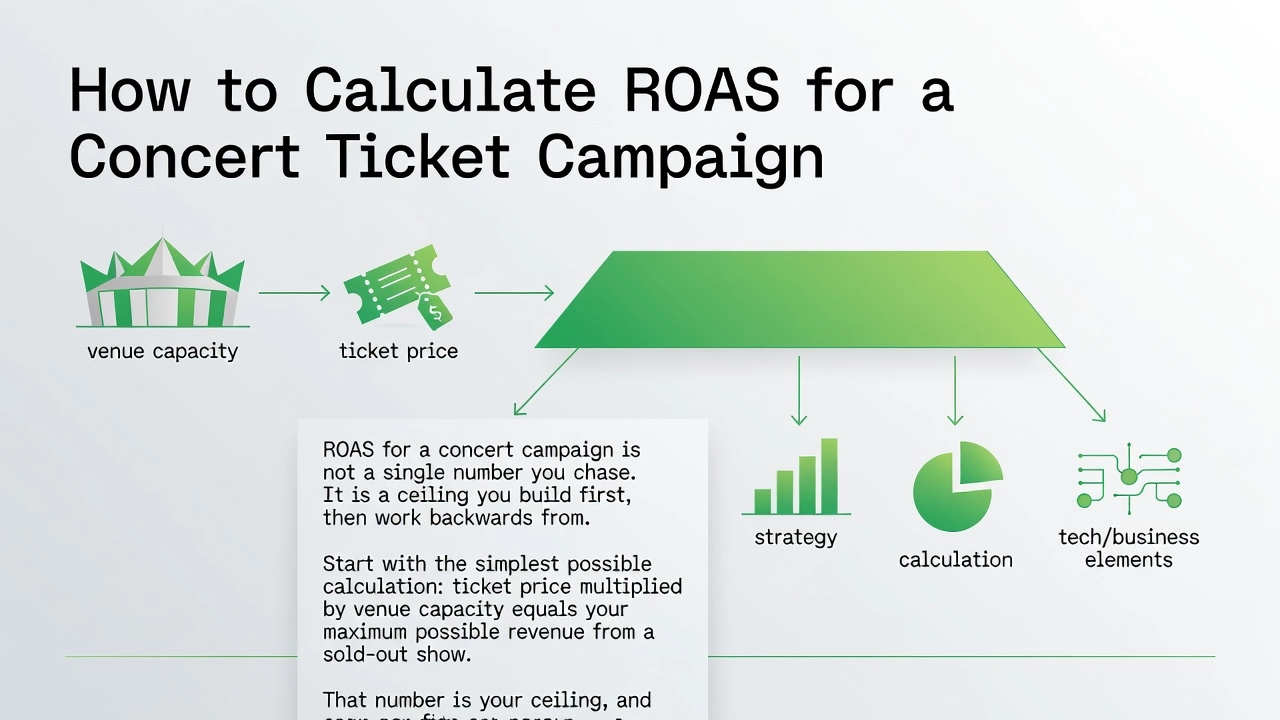
ROAS for a concert campaign is not a single number you chase. It is a ceiling you build first, then work backwards from.
Start with the simplest possible calculation: ticket price multiplied by venue capacity equals your maximum possible revenue from a sold-out show. That number is your ceiling, and every decision about ad spend should be benchmarked against it, not against generic industry averages that have no relationship to your specific show economics. A 200-capacity room at $50 per ticket produces a
The $500-to-$40K Framework in Practice
The circulating case study of $500 in Meta spend driving $40,000 in concert ticket revenue represents an 80x ROAS ceiling against that specific show's economics. In practice, paid ads rarely drive every ticket sold; organic social, email lists, and word of mouth all contribute. But even if Meta ads account for 25 to 30 percent of venue capacity filled, a $500 spend against a $40,000 ceiling produces a 20x to 24x return on attributed revenue. That is a highly favourable outcome by any measurement standard, and it only becomes visible when you have conversion tracking in place to attribute purchases to the campaign. Without a correctly firing Conversions API connected to your ticketing platform's purchase event, none of these numbers are claimable. You are spending against a ceiling you cannot see.
What Near-Zero ROAS Actually Tells You
The failure case,
ROAS Beyond the Final Night
The direct post-show ROAS calculation captures only the immediate revenue from tickets sold, but the campaign generates assets with compounding value. Seventy-five percent of streams driven by a conversion-optimised music campaign occur after the campaign ends, carried forward by saves and playlist adds. The same logic applies to concert campaigns: the email captures and retargetable custom audiences built during the ticket push represent warm audiences for the next show in the same city, acquired at near-zero incremental cost. A custom audience of people who clicked your concert ad but did not purchase is not a failed lead. It is a warm retargeting pool for the next date, and its value does not appear in any single show's ROAS calculation.
The Audience Asset You Are Building, Not Just the Tickets You Are Selling
Every euro you spend on a concert Meta campaign is doing two jobs simultaneously, and most artists only measure one of them. The obvious job is selling tickets for the specific date being promoted. The invisible job is building an audience infrastructure that makes every future campaign cheaper, faster, and more precisely targeted. Treating these as separate outcomes misses the compounding logic that separates artists who scale their touring from those who restart from zero every single show.
The Email List You Are Building in Real Time
When your ad drives traffic to a dedicated landing page rather than directly to a ticketing platform, every visitor who opts in becomes a verified, permission-based CRM contact. Unlike organic social followers, this list is yours. It is not subject to algorithmic reach throttling, feed changes, or platform policy shifts. A single structured campaign with a well-designed landing page can add hundreds of qualified fan contacts to your list, contacts that would otherwise require months of consistent organic activity to accumulate. When the next show announcement is ready, activating that list costs nothing beyond the email send itself.
The Retargeting Pool That Compounds Across Shows
Video viewers, landing page visitors, and past ticket purchasers seeded during one campaign become your warmest possible audience segments for the next. Someone who watched 50% of your Show A video ad is already pre-qualified for Show B retargeting at near-zero incremental acquisition cost. Past purchasers, when properly captured through CAPI-enriched conversion events, become both a direct retarget segment and a Lookalike seed to find new fans with identical behaviour profiles. This is the compounding mechanism: cold-to-warm conversion during one campaign directly reduces cost-per-acquisition in every subsequent campaign targeting the same market.
The Infrastructure Investment That Pays Across a Career
The marginal cost of properly implemented CAPI-enriched tracking is small relative to total campaign spend. Its benefit, however, is not marginal and not limited to one campaign. Cleaner conversion signals produce better algorithmic optimisation today. The audiences those signals build reduce CPAs tomorrow. The Lookalikes seeded from verified purchasers improve targeting accuracy for every tour date after that. The artists who install this infrastructure early are not paying for better results on a single show; they are compressing years of audience-building into each campaign cycle, and song.so's CAPI layer ensures every signal that leaves your campaign is clean, bot-filtered, and adblock-bypassed so Meta's algorithm rewards your spend with the reach and optimisation it actually deserves.
The Campaign System That Closes the Attribution Gap
Every concert Meta ad campaign that scales profitably is built on the same five structural requirements: Conversions objective, geo anchor, CAPI-enriched tracking, a single-destination smartlink, and authentic short-form vertical video creative. Run your current setup against that list right now, before spending another dollar. Not as a theoretical exercise. As a yes/no audit where every "no" answer maps directly to a category of wasted spend and a category of signals Meta's algorithm never received.
The question that surfaced in the opening of this guide, "how do you know if it worked?", has a specific structural answer. Artists who build the infrastructure to answer it can scale spend with confidence and compound audiences across every show they promote. Artists who cannot answer it are making budget decisions based on incomplete data, and the algorithm is optimising toward ghost clicks rather than real buyers. That is the entire explanation for the gap between $500 producing $40,000 in ticket revenue and
song.so is the infrastructure layer built specifically to close that gap for music advertisers. Bot filtering removes non-human traffic before it contaminates your conversion signals. Adblock bypass ensures the roughly one in three potential ticket buyers using an ad blocker does not disappear from your attribution entirely. CAPI enrichment sends verified, server-side purchase events directly to Meta's Conversion API, surviving every cross-domain redirect in the ad-to-ticket chain that strips pixel cookies. Every euro you spend reaches a verified fan, not a ghost click the platform cannot see.
Conclusion
Selling out your next show is not a matter of luck. It is the result of smart, intentional advertising. By mastering Meta ads, you now have the tools to fill every seat consistently.
Here are the key takeaways to carry forward: precise audience targeting puts your ads in front of fans who are ready to buy; compelling creative stops the scroll and builds excitement; and optimizing your campaigns as event day approaches maximizes every dollar spent.
The difference between a half-empty venue and a sold-out crowd often comes down to your advertising strategy. Meta's platform gives you the reach, the data, and the targeting power to make sold-out shows your new standard.
Start building your first campaign today. Pick an upcoming show, apply what you have learned here, and watch your ticket sales grow. Your next sold-out night starts now.