Spotify Deep Link URLs: What They Are and Why Your Ads Need Them
Have you ever clicked a link and been taken straight to a song, playlist, or artist page inside the Spotify app? That's the magic of deep linking, and it's something your ads could seriously be missing out on.
If you're running ads that promote music, podcasts, or anything Spotify-related, a Spotify deep link URL is one of the simplest ways to improve your results. Instead of sending people to a generic webpage, you send them directly into the Spotify app with exactly the content you want them to hear. No extra steps, no friction, just one tap and they're there.
The good news is that creating these links doesn't require any technical skills. In this tutorial, you'll learn what Spotify deep link URLs actually are, why they matter for your advertising campaigns, and how to generate them for free using a simple tool. By the end, you'll be ready to start using them in your own ads right away. Whether you're a musician, a marketer, or just someone curious about how this all works, you're in the right place.
What Is a Spotify Deep Link URL?
Think of a Spotify deep link as a shortcut that skips the scenic route. Instead of dumping your listener into a browser tab where they have to log in, find the track, and press play, a deep link opens the Spotify app directly on the exact song, album, playlist, or artist page you want them to see. One tap, and they're already listening.
The way this works under the hood is slightly different depending on the device. On iOS, the technology is called a Universal Link; on Android, it's called an App Link. They behave similarly from the listener's perspective, but the technical setup behind each is distinct. A well-built generator handles all of that automatically, detecting the device and serving the right format without you needing to know anything about apple-app-site-association files or assetlinks.json. You just paste in your Spotify URL and get a clean, working deep link back. According to Spotify's own iOS developer documentation, the app registers a specific URI scheme to handle these links, and the fallback behavior needs to be deliberately engineered, not assumed.
That fallback matters more than people realise. If someone clicks your link and Spotify isn't installed on their phone, a poorly built link just breaks. A properly built one redirects gracefully to the Spotify web player so the listener still hears your music, no dead ends.
There's also a more advanced format worth knowing about: the playlist-context deep link. A standard track link opens your song in isolation. A playlist-context deep link opens your track inside a specific playlist, so when your song finishes, the playlist keeps playing. This is particularly useful if you've secured a playlist placement and want the algorithm to register real listening behaviour, not just a single isolated play. Deep linking a track within a playlist is a genuinely different tactic from plain track linking, and it signals much richer engagement back to Spotify.
Here's the part that catches most artists off guard: the standard share URL you copy from Spotify, the open.spotify.com link, does not reliably open the app on mobile. When someone clicks that link inside TikTok, Instagram, or Facebook, those platforms trap it inside their own built-in browser. The listener gets a web page, gets asked to log in again, and often gives up before the track even loads. A proper deep link sidesteps all of that friction entirely.
Why Deep Links Matter for Paid Music Ads
Here's the hard truth about paid music ads: getting someone to tap your ad is the easy part. Getting them from that tap into actually playing your track inside Spotify is where most budgets quietly bleed out.
When a listener taps your Instagram, Facebook, or TikTok ad, the platform doesn't hand them off to their native browser. It opens the link inside its own built-in browser, a sandboxed mini-browser that lives inside the social app itself. Spotify's app has no idea that browser exists. So instead of your track opening immediately, the listener hits a login wall, gets asked to re-authenticate, or lands on a web player that feels nothing like the experience they expected. Most people don't push through that friction. They close it and keep scrolling, and your ad budget just paid for a ghost click.
Research into deep linking for the Spotify mobile app confirms this is one of the most common reasons paid music campaigns underperform. The fix sounds simple, but there's an important nuance worth understanding: bypassing the in-app browser is actually a separate step from generating a deep link. Some tools create a deep link that points to Spotify correctly, but still open inside the social app's browser, which defeats the purpose entirely. The tools that actually work for paid campaigns on Meta and TikTok do both things: they push the user out to Safari or Chrome first, and then hand them into the Spotify app. That two-step handoff is what makes the difference.
The numbers behind this are hard to ignore. Google data cited across the deep-link industry shows 3x higher conversion rates when users are routed into a native app versus a browser experience on social platforms. Deep-linked journeys can also produce up to 6x higher click-to-install rates compared to standard links, meaning a dramatically larger share of the people your ad reaches actually end up inside Spotify and engaging with your music.
Put that against a real budget. Reaching 1 million streams on Spotify via targeted Meta ads in 2026 costs roughly $500 per song. At that spend level, every percentage point of friction you remove is money that turns into actual streams instead of wasted impressions. A properly built deep link on your landing page is one of the cheapest optimizations you can make, and it directly affects how far that $500 goes.
How to Generate a Spotify Deep Link for Free
The good news: you do not need an account, a credit card, or any technical knowledge to get started. Head straight to song.so/spotify-playlist-deeplink and the generator is ready to use immediately, no signup required.
Step 1: Grab Your Spotify Link
Open Spotify on your phone and navigate to the track or playlist you want to promote. Tap the three-dot menu (you will see it in the top-right corner of any track or playlist page), then select Share, then Copy Link. That gives you a standard open.spotify.com URL. This is the raw link Spotify generates by default, and it is exactly what you will paste into the generator next.
Step 2: Paste and Choose Your Link Type
Back in the song.so generator, paste that URL into the input field. Now you make one important choice: do you want a plain track deep link or a playlist-context deep link?
A plain track deep link opens just the song on its own. A playlist-context deep link opens the track inside the playlist, so when your promoted song finishes, the playlist keeps rolling instead of stopping. For anyone running ads around an editorial pitch or a playlist placement, the playlist-context version is the one you want. One important caveat: your track must already be inside the playlist you select, otherwise the link will simply open the track on its own without the playlist queue.
Step 3: Copy and Deploy
The generator outputs a URL built for both iOS Universal Links and Android App Links, with an automatic web player fallback for anyone who does not have the app installed. Copy that link and drop it directly into your Meta or TikTok ad creative, your bio link, or your smart link landing page. The whole process takes under two minutes, and the link works across every placement without any extra configuration on your end.
What a Deep Link Alone Does Not Do (The Part Every Free Tool Skips)
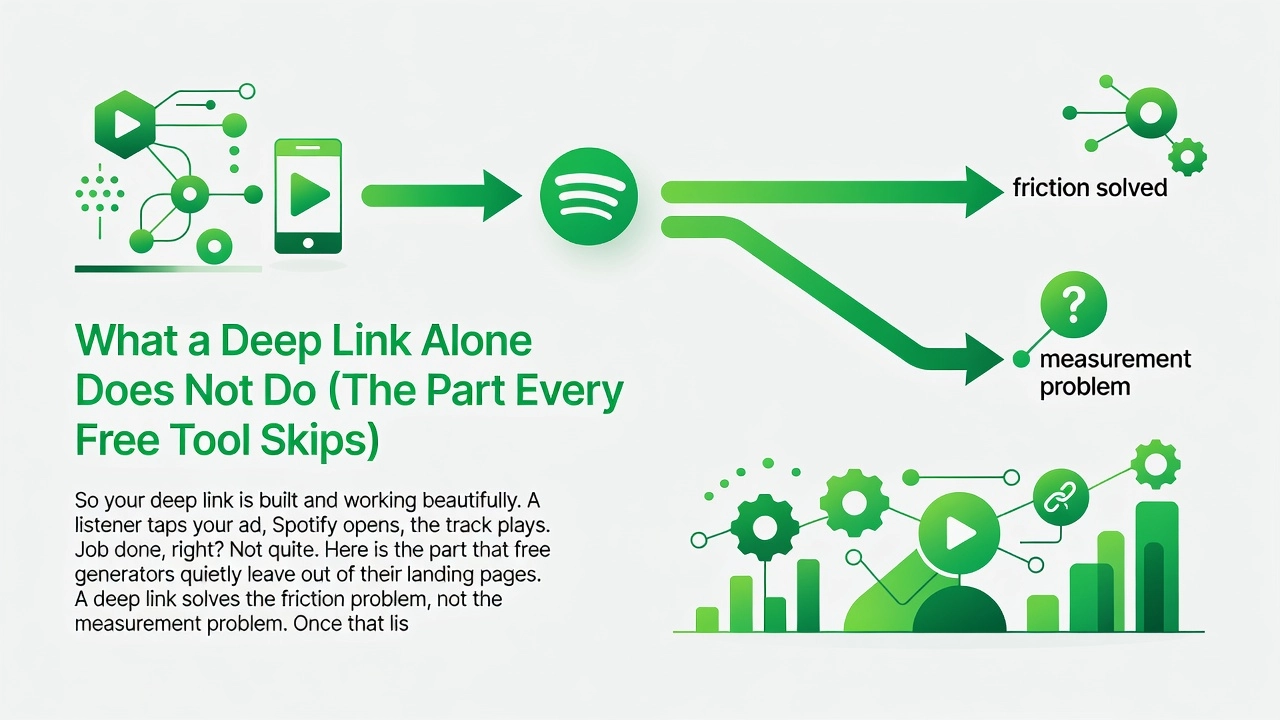
So your deep link is built and working beautifully. A listener taps your ad, Spotify opens, the track plays. Job done, right?
Not quite. Here is the part that free generators quietly leave out of their landing pages.
A deep link solves the friction problem, not the measurement problem. Once that listener disappears into the Spotify app, Meta and TikTok have absolutely no idea what happened next. Did they stream 30 seconds? Save the track? Follow the artist? From the ad platform's perspective, the story ends at the click. There is no verified signal confirming that any of those valuable actions occurred, which means the algorithm has nothing real to learn from.
This gets worse when you factor in iOS App Tracking Transparency and the steady rise of adblockers. Browser-based pixels, the kind every free generator relies on, are estimated to capture only 60 to 70% of real conversion events in 2026. Pairing a pixel with a server-side Conversions API lifts that accuracy to 85 to 95% and typically cuts cost-per-acquisition by 15 to 25% in the first month. Without that server-side layer, Meta and TikTok are optimizing against a partial picture and throttling your delivery because the signal pool looks thin. You pay more to reach fewer people.
Then there is bot traffic. A meaningful share of every ad campaign's clicks comes from non-human sources. Without a filtering layer sitting in front of your link, those ghost clicks inflate your reported numbers and feed corrupted signals directly into the algorithm's lookalike modeling. The result is an audience that looks bigger but converts worse over time.
The real cost of a free generator is never the tool itself. It is the ad spend that disappears unattributed. Every conversion Meta cannot see is a data point it cannot use to sharpen targeting, and that gap compounds with every campaign you run.
Playlist-context links make this especially sharp. A listener enters your playlist, streams your track, maybe saves it. None of that activity generates any campaign-level signal. Per Spotify's own marketing guidance, connecting in-app actions back to specific ad spend requires deliberate attribution setup that a bare deep link simply does not activate. That $500 you spent driving playlist clicks produced real listening behavior, but your campaign learned nothing from it.
How song.so Closes the Gap Free Generators Leave Open
This is where song.so goes beyond what any free generator can offer, and for an indie artist spending real money on paid campaigns, the difference is enormous.
The first thing song.so does is filter the noise before it reaches your data. Every ad campaign attracts a percentage of non-human traffic, bots and ghost clicks that look like real activity but produce zero streams, saves, or followers. Free generators pass all of that straight through to your destination URL. song.so places a bot-filtering and adblock-bypass layer between your ad and your Spotify deep link, so only verified human clicks make it to the conversion event. Your campaign data stays clean from the very first click.
The second gap is where most indie artists quietly lose the most. Free tools rely on browser-based pixels to track conversions. iOS's App Tracking Transparency framework and the growing share of users running adblockers both block those pixels regularly, meaning a significant chunk of your real conversions simply disappear from the record. song.so skips the pixel entirely and sends enriched conversion events directly to Meta's Conversion API and TikTok's Events API server-side. The signal travels from song.so's servers to the platform's servers, so it arrives regardless of whether a listener has opted out of tracking or has an adblocker running in the background.
Those clean signals do something powerful to your ad delivery. When Meta and TikTok receive high-quality data confirming that real, high-intent fans are engaging with your ad, their algorithms reward you with better delivery, lower cost per thousand impressions, and lookalike audiences built from people who actually resemble your listeners.
The landing pages song.so builds are also scored by Meta's Andromeda system, which evaluates destination quality as a factor in ad auction competitiveness. A higher-quality destination improves your position in the auction independently of your bid.
Put it all together for a $500 campaign and you get a real-time dashboard showing exactly which stream, save, and follower came from which ad. That is an auditable story you can act on, not a guess.
Free Deep Link Generator vs. song.so Full Stack: What You Actually Get
Here is the simplest way to think about it: a free deep link generator does one job, and it does that job well. It removes the friction between your ad and the Spotify app, so your listener lands on the right track in one tap instead of bouncing around a browser. That is genuinely valuable. If you are just starting out and you do nothing else, building a proper deep link is still a meaningful upgrade over a plain Spotify URL.
The gap opens up the moment you ask a different question: did that tap actually turn into a stream, a save, or a follower? Every free generator on the market stops at the routing layer. None of them verify whether the click produced a real conversion, filter out bot traffic, bypass adblockers, or send a clean signal back to Meta or TikTok. They operate entirely at the browser-pixel level, which sounds fine until you look at the numbers. Music ad campaigns running pixel-only attribution lost between 20 and 40 percent of conversion data in 2025, and that number compounds with every iOS update and every new adblocker rule. With global ad-blocker usage crossing 33 percent in 2025, a browser-pixel-only setup is not just incomplete; it is a structural dead end for anyone spending real budget on paid campaigns.
Adding CAPI on top of a browser pixel recovers roughly 13 to 19 percent more attributed conversions on average, with music-specific campaigns seeing around 30 percent more attributed conversions compared to pixel-only tracking. That difference directly affects how the algorithm allocates your next impression.
Song.so is built around this exact problem. The deep link is still there, doing its listener-side job. But wrapped around it is bot filtering, an adblock bypass layer, server-side Conversion API and TikTok Events API enrichment, and landing pages tuned for Meta's Andromeda ranking. The result is that every conversion signal leaving your campaign is clean and visible to the algorithm, not a ghost click that gets ignored or miscounted.
For anyone spending even a modest daily budget on Meta or TikTok music ads, the real question is never whether the deep link was free. It is whether the conversions it generates are visible, verified, and usable by the algorithm to find the next person who will actually press play.
Start With the Deep Link, Then Make Every Click Count
Start at song.so/spotify-playlist-deeplink, generate your deep link, and drop it into your smart link landing page or ad destination. Never send a raw Spotify share URL directly from a paid ad. Those standard open.spotify.com links open in a mobile browser, not the app, and on social traffic that means lost plays, lost saves, and a frustrating experience for the listener you just paid to reach.
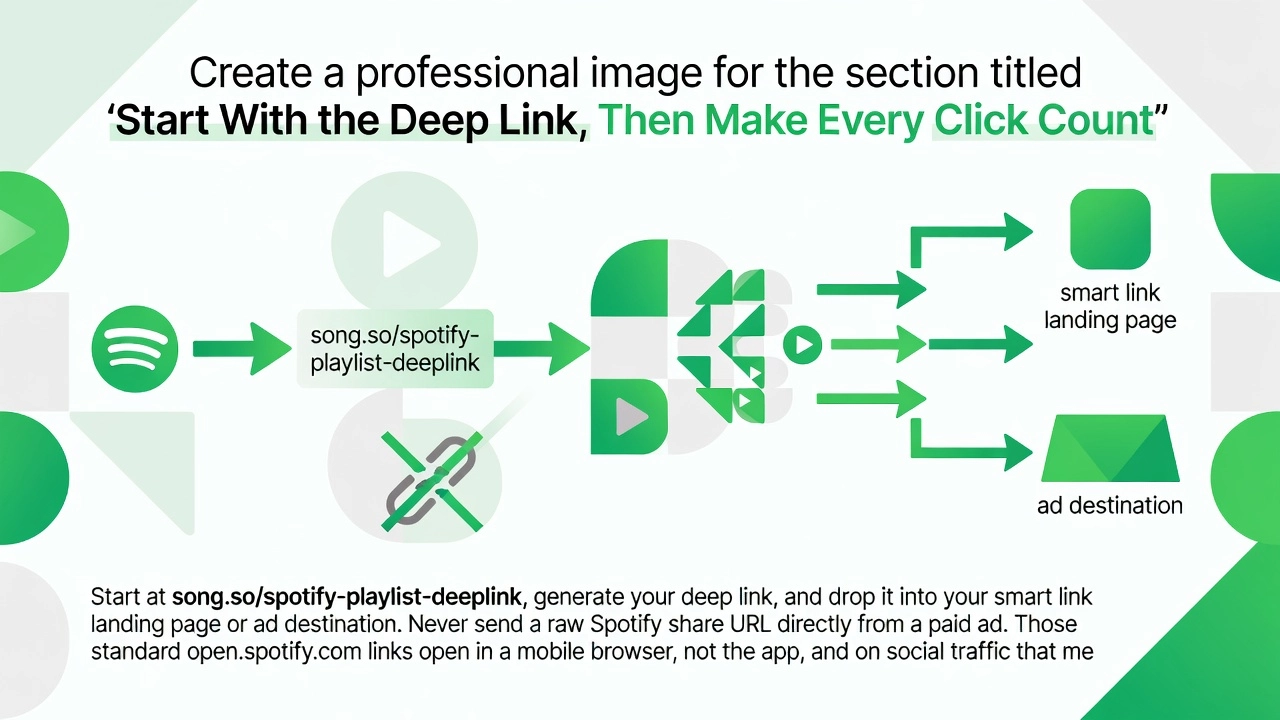
Once the deep link is in place, though, be honest with yourself about what it actually solves. It removes the friction between the tap and the track. It does not tell Meta or TikTok that a real stream happened. The gap between a listener opening Spotify and a verified, algorithm-visible conversion is still wide, and no free tool bridges it.
That is exactly where layering song.so on top of the deep link changes the outcome. The bot filtering removes fake clicks from your optimisation data. The adblock bypass recovers conversion signals that browser pixels would have lost entirely. The CAPI enrichment sends a clean, server-side signal directly to Meta and TikTok, so the platforms can see what your budget actually produced and reward your campaigns with better delivery.
The artists winning in the post-iOS era are not the ones with the biggest budgets. They are the ones whose every click is clean, verified, and visible to the algorithm. Better data means better reach, and better reach means the music finally gets heard by the people who will genuinely love it.
Conclusion
Spotify deep link URLs are a simple but powerful upgrade for any ad campaign promoting music or audio content. To recap the key takeaways: deep links send listeners directly into the Spotify app, removing friction and improving the overall user experience. They require zero technical skills to create, and they can meaningfully boost engagement and conversion rates for your ads. Best of all, you can generate them for free in just a few seconds.
Now it is your turn to put this into action. Head over to the link generator, create your first Spotify deep link, and drop it into your next ad campaign. The difference in performance might surprise you. Small optimizations like this one add up quickly, and your audience deserves a seamless path to the content you are promoting. Start linking smarter today.