Spotify Playlist Growth vs. Direct Track Ads: Which Wins?
Every dollar you spend on music promotion needs to work harder than the last. Yet countless artists are pouring their budgets into the wrong strategy simply because they never stopped to compare their options side by side. If you have been running ads for your music with mixed results, the real question might not be about your targeting or your creative. It might be about the fundamental approach you are taking.
The debate around spotify playlist growth campaigns vs. direct track ads for music promotion is one that divides marketers, artists, and managers across the industry. Both strategies promise streams, exposure, and fan growth. But they operate on completely different logic, timelines, and conversion paths. Choosing the wrong one for your goals can mean wasted spend, inflated numbers that go nowhere, and missed opportunities to build something lasting.
In this breakdown, you will get a clear, honest comparison of both approaches. We will cover how each strategy works, where each one wins, and how to decide which method deserves your budget based on where you are in your career right now.
What You Are Actually Comparing
Before any budget decision can be made intelligently, you need to understand that these are not two versions of the same tactic. They operate at structurally different layers of the listener acquisition funnel, generate different signals for Spotify's algorithm, and solve different problems depending on where an artist sits in their career.
Playlist growth campaigns place a track directly inside an active listening environment on Spotify. The listener chose to press play; they were not interrupted. Every save, stream completion, repeat listen, and playlist addition that follows sends engagement data straight into Spotify's recommendation engine, feeding Discover Weekly, Release Radar, and Radio from within the platform. The algorithm reads those signals as genuine listener preference and, when thresholds are met, begins distributing the track to similar audiences organically.
Direct track ads via Meta (Instagram and Facebook Reels, Stories) or TikTok work entirely differently. They intercept passive scrollers off-platform, route them through a landing page, and require multiple conversion steps before any streaming signal is generated at all. The drop-off across those steps is real. However, the listeners who complete that funnel are high-intent, and their subsequent saves and repeat behaviour sends significantly richer audience-profile data back to Spotify than a passive playlist listener who never consciously chose the song. As Vohnic Music's 2026 analysis puts it: the algorithm does not care where listeners come from; it cares what they do once they arrive.
A third category sits between the two and is routinely conflated with Meta or TikTok direct ads: Spotify Ads Studio. It runs audio and display inventory within the platform itself, but carries a $250 minimum spend in the US and reaches only the ad-supported free tier, approximately 460 million listeners. That is a fundamentally smaller addressable pool than Meta's 3.4 billion daily active users across its properties in 2026, and the economics reflect it. Confusing Spotify Ads Studio with off-platform direct track campaigns is one of the most common and costly errors in music promotion budget planning.
According to Chartlex's comparison of 500+ campaigns, playlist promotion delivers a cost per stream of $0.008 to $0.04, against $0.05 to $0.30 for Meta ads, representing a 2 to 5x efficiency gap on raw streaming volume. But raw volume is only one variable. The more important question is which signals each strategy actually produces, because Spotify's algorithm weights saves, completions, repeat listens, and listener taste profiles, not stream counts in isolation. That distinction is the prerequisite for everything that follows in this comparison.
The Numbers Side by Side
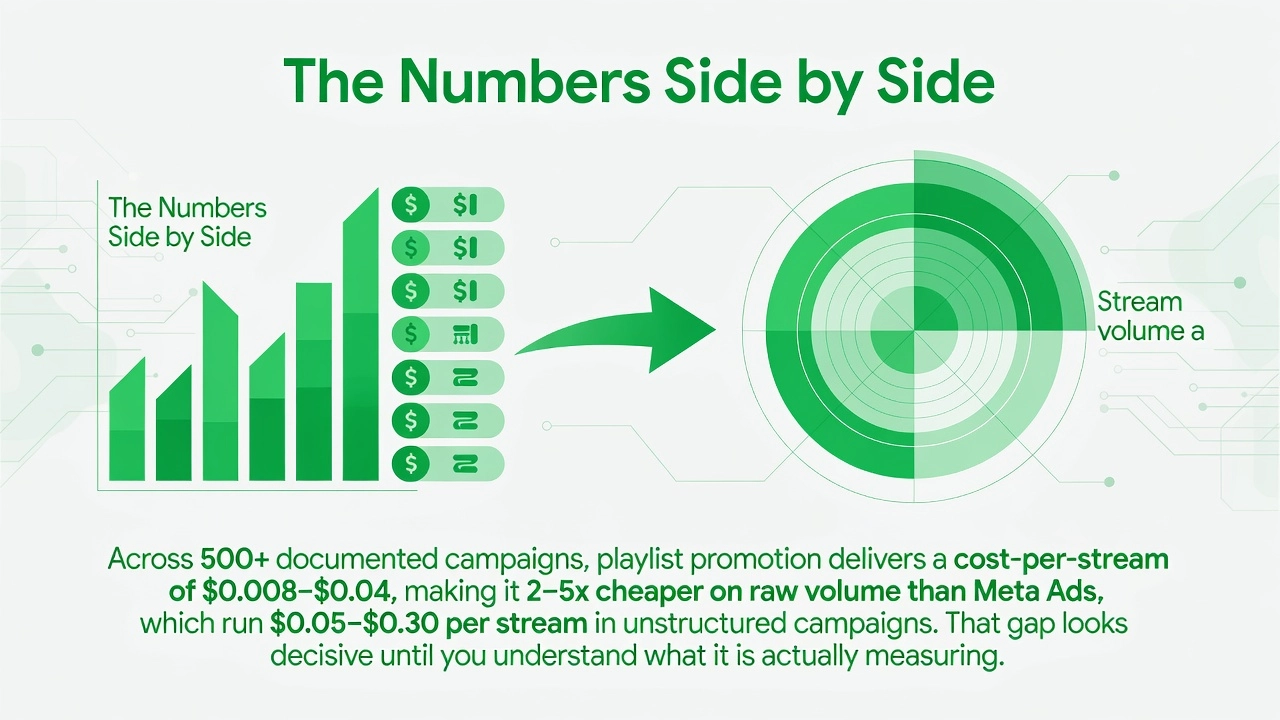
Across 500+ documented campaigns, playlist promotion delivers a cost-per-stream of $0.008–$0.04, making it 2–5x cheaper on raw volume than Meta Ads, which run $0.05–$0.30 per stream in unstructured campaigns. That gap looks decisive until you understand what it is actually measuring. Stream volume and algorithm-activating signal quality are not the same number, and conflating them is the most expensive mistake independent artists make when allocating a release budget.
Within playlist promotion, the variance between services is substantial. YouGrow Promo delivers approximately $0.02 CPS from a $77 minimum; Daimoon Media comes in at roughly $0.03 CPS from $57; Playlist Push reaches a comparable $0.04 CPS but requires a $285 minimum spend; SubmitHub's pay-per-pitch model produces an estimated $0.11 CPS across a $30– The Meta Ads versus Spotify Ads Studio comparison is more straightforward, and the numbers consistently favor Meta. Across 2,400+ artist campaigns, the data shows Meta CPS at $0.02–$0.05 against Spotify Ads Studio's $0.10–$0.20; Meta CPM at $5– One caveat applies to every benchmark above: these figures describe well-structured, properly attributed campaigns. Most independent artists do not run well-structured campaigns. A first-time Meta advertiser targeting broad audiences and optimizing for link clicks is more likely to pay $0.38 per stream than $0.05. Campaigns with broken pixel events, no server-side conversion layer, or direct-to-Spotify links without a landing page intermediary produce numbers that appear similar in a spreadsheet while delivering materially degraded signals to Spotify's ranking system. The benchmark is achievable; it is not the default. Raw stream volume, as covered in the previous section, tells you almost nothing about whether a campaign is actually working. The metric that determines whether Spotify's recommendation engine activates on your track is save rate, and the structural difference between playlist promotion and direct track ads becomes most visible here. Industry data confirms that tracks with save rates above 5% are significantly more likely to receive algorithmic placement in Discover Weekly, Release Radar, and Radio. Tracks that fall below 2% face active suppression. Tracks with save rates at 3% or higher outperform low-save equivalents by 4x on downstream algorithmic reach, across data from more than 2,400 campaigns. That gap is not marginal. It determines whether a campaign generates compounding algorithmic momentum or simply disappears after the budget runs out. The core problem with passive playlist listening is behavioural, not incidental. A listener who opens a lo-fi study playlist and hears your track as the sixth song did not choose you. They chose a mood. Without a deliberate act of engagement, such as a save, a repeat listen, or a profile follow, Spotify's system accumulates almost no usable data about who your audience is. The algorithm cannot build a listener profile from a skip-free play alone, and when the playlist placement ends, the stream count drops back to zero with no lasting algorithmic activation behind it. This passive structure also systematically underproduces every secondary signal the algorithm weights. Completion rate, playlist-add rate, return-listen count, and profile follows all require a degree of intent that passive listening rarely generates. Early skips before 30 seconds are a confirmed negative input. A listener who never chose the song is unlikely to replay it, add it to a personal playlist, or visit the artist profile. Each missing signal is a data point Spotify needed and did not receive. A listener acquired through a direct track ad operates in a completely different behavioural frame. Someone who saw a vertical video Reel, stopped scrolling, tapped through, and pressed play has already made three deliberate decisions before the track starts. Virra Marketing notes that Spotify "wants to see lots of streams coming through to the song that are real and see people repeatedly listening to the song," which is precisely the pattern that intentional ad-driven listeners produce. Their saves, replays, and follows feed Spotify's collaborative filtering layer with the kind of behavioural cluster the recommendation engine needs to identify similar listeners and expand distribution organically. Bot streams sit at the opposite extreme. Spotify removed over one billion fake streams in 2024, and the fraud detection system has matured to the point where triggering fake-stream patterns actively damages an artist's profile rather than merely failing to help it. Stream source and quality are now competitive variables, not background considerations. The arithmetic that actually matters is this: a playlist placement delivering 10,000 streams at a 1.5% save rate produces roughly 150 saves and minimal secondary engagement, which is unlikely to meet the threshold for algorithmic activation. A well-structured Meta ad campaign delivering 800 intentional streams at a 7% save rate produces 56 saves from listeners who chose the track, alongside stronger completion rates, return listens, and follow data. The smaller number, built on cleaner signals, is more likely to trigger the recommendation engine and generate compounding streams that long outlast the campaign spend. Volume is a lagging indicator; signal quality is the variable that determines whether the algorithm works for you or ignores you entirely. Every cost-per-stream benchmark in the previous sections carries a hidden assumption: that the clicks being measured are real, that the platforms can see them, and that the data flowing back into Meta or TikTok's optimisation engine reflects what actually happened. In most indie artist campaigns running today, none of those assumptions hold. Here is the structural problem. When a listener clicks a Meta or TikTok ad and lands on Spotify, tracking terminates at the platform boundary. Spotify for Artists does not distinguish between a listener who arrived from a paid Instagram Story, an organic Reddit post, or a playlist placement; it reports all of them inside a single undifferentiated "external" bucket. This means the true channel ROI of a playlist growth campaign versus a direct track ad is invisible by default, unless a conversion-tracking layer is inserted between the ad click and the Spotify destination. Without that layer, artists are correlating stream lifts and guessing. They are not attributing. The pixel-side problem compounds this. Since Apple's App Tracking Transparency rollout in 2021, Meta's browser pixel has been progressively blinded to iOS user behaviour. iOS 17 stripped click identifiers from Safari Private Browsing; iOS 18 expanded that stripping further. Meta's January 2026 deprecation of the 7-day view and 28-day view attribution windows caused reported conversions to drop 15 to 30 percent overnight, not because campaign performance fell, but because measurement degraded. Attribution accuracy for Meta ads has deteriorated by an estimated 40 to 60 percent over the 18 months to early 2026. The operational fix is Meta's Conversions API (CAPI): a server-to-server endpoint that routes verified conversion events directly to Meta, bypassing browser-side blocking entirely. Music-vertical campaigns running pixel combined with CAPI see approximately 30 percent more attributed conversions and 15 to 25 percent lower learning-phase cost-per-lead versus pixel-only setups, with the largest performance deltas occurring on smart-link redirect funnels where pixel cookies are stripped at the Spotify handoff. TikTok's Events API operates as the parallel infrastructure on that platform, and the same logic applies. Global ad-blocker installation exceeded 33 percent in 2025, and among younger, more tech-savvy music listeners, that figure is likely higher. Brave and Firefox Strict mode block the Meta Pixel script by default. A meaningful share of music ad clicks never register in Meta's event system at all, which suppresses the conversion volume the platform needs to exit the learning phase. Meta typically requires around 50 qualifying conversion events per week to optimise efficiently; ad-blocker suppression can hold campaigns in the learning phase indefinitely, burning budget against unoptimised delivery. This creates a false economy inside the raw CPS numbers discussed earlier. A $0.02 cost-per-stream figure from a pixel-only campaign is not the same signal as $0.02 from a CAPI-enriched campaign. In the first case, Meta's algorithm is calibrating against noise. In the second, it is calibrating against verified fan behaviour. The number looks identical; the underlying data quality is not. Meta's Andromeda ad-ranking system uses landing-page engagement signals as a delivery-quality input. A smartlink that filters bots, bypasses ad blockers, and routes clean events back via CAPI gives Andromeda better signal to work with, which should reduce effective CPM over the campaign's life. Two campaigns that open at identical cost-per-stream figures can diverge significantly over 30 days if one is feeding clean server-side events and the other is not. That divergence is invisible inside a standard Ads Manager view. This is the gap song.so is built to close. Its bot-filtering and adblock-bypass layer sits between the ad and the destination, ensuring only verified, enriched conversions reach Meta CAPI and TikTok Events API. Both platforms then optimise against real fan behaviour rather than ghost clicks. That infrastructure fix is not a nice-to-have enhancement layered on top of a campaign strategy; it is the precondition that makes the playlist growth versus direct track ad comparison meaningful in the first place. Without clean data flowing in both directions, the channel comparison this post is built around is, structurally, a comparison of two noise sources. The statistics that open this section are worth sitting with for a moment. According to Luminate's 2025 mid-year report, 88% of tracks on major streaming platforms never cross 1,000 streams. Spotify's own Loud & Clear 2025 data puts the number of artists globally who surpassed 1,000 monthly listeners at just 1.4 million. In that context, a first promotion budget is not about chasing volume. It is about generating clean, readable signals that tell you whether the song connects and give the platforms enough data to work with. For artists working with a budget under $300, playlist promotion through services like Daimoon Media (starting at $57, cost-per-stream approximately $0.03) or YouGrow Promo (starting at $77, cost-per-stream approximately $0.02) is the lower-risk entry point. There is no ad creative to produce, no campaign structure to misconfigure, and no pixel to install incorrectly. The stream volume delivered is genuine, even if the algorithmic downstream is weaker than what a well-structured Meta campaign can produce. For a first release, removing execution variables and focusing on the music's actual reception is the right trade-off. A budget of Beginners who want to move directly to Meta ads should narrow the setup to its simplest viable form: one vertical video in 9:16 Reels or Stories format, a daily budget of $20 to $50 during the learning phase, and a smartlink landing page sitting between the ad and Spotify to capture the conversion event. That last element is non-negotiable. Without an intermediary landing page that fires a verified conversion signal back to Meta, the platform has nothing to optimise against except clicks. And that leads directly into the biggest structural mistake beginners make. Optimising a campaign for link clicks instead of engagement events is the single most common and most damaging error in beginner Meta music campaigns. A campaign that delivers 5,000 clicks to Spotify but generates no verified save events tells Meta's algorithm nothing useful. Worse, it actively trains the system to find more people who click and bounce, compounding the problem with every dollar spent. Per Chartlex's analysis of playlist promotion vs. Facebook ads, the additional friction of the click-to-Spotify funnel amplifies this drop-off risk at every step. Whether a beginner chooses playlist promotion or Meta ads, the first diagnostic metric to track is not streams; it is save rate. Per Emitha's 2026 Spotify promotion guide, save rates above 5% correlate strongly with algorithmic playlist placement, while tracks falling below 2% risk active suppression. If your save rate sits below that 2% threshold on either channel, the problem is the creative or the targeting, not the channel itself. Switching channels without fixing the underlying issue just replicates the same result with a different invoice. Clean, measurable early signals are worth more than inflated stream counts that Spotify cannot act on. Three signals tell you it is time to move beyond playlist-only promotion. Your documented save rate from playlist placements is consistently above 3%, which data from Chartlex identifies as the threshold where a track has a 58% higher probability of triggering a Discover Weekly placement within 14 days. You have a back catalogue of at least two or three releases, giving you enough conversion history to build retargeting audiences worth targeting. And you have at least one release where stream lift was measurable rather than inferred, meaning you can point to a specific campaign input and a specific output, not just a week where numbers looked good. If all three conditions are true, continuing to rely exclusively on playlist placements is leaving structural value on the table. Moving into direct Meta or TikTok ads does not automatically produce better results. Most campaigns that fail at this stage do so for predictable, avoidable reasons. The first failure mode is optimising for link clicks rather than engagement events. Link clicks are cheap and structurally meaningless for music promotion; they tell the platform nothing about whether the listener stayed, saved, or came back. The second failure mode is a weak or absent landing page between the ad and Spotify. Without a conversion-optimised landing page in that gap, a large proportion of clicks never complete the journey to the DSP, and none of the conversion data is recoverable for the algorithm. The third failure mode is broad audience targeting, which generates impressions from people unlikely to engage with the genre, feeds Spotify behavioural signals of low quality, and actively dilutes the engagement rate the algorithm uses to decide what the track deserves. Structured campaign architecture, not budget size, is the variable that separates campaigns that compound from campaigns that drain. This is the structural separation point between direct ads and playlist promotion that no cost-per-stream comparison captures. A verified Meta custom audience built from confirmed campaign conversions can be used for lookalike expansion on the next release. Playlist placements generate streams; they generate no portable audience asset whatsoever. Every campaign built on verified conversion data adds to an owned audience that reduces the cold-targeting cost on future releases, improves lookalike match quality, and gives the artist direct re-reach without paying an intermediary again. That compounding effect across a release cycle is why intermediate artists who run well-structured direct campaigns tend to see the cost of new-listener acquisition fall over time, while playlist-dependent artists restart from zero with each release. For advanced artists and their teams, Meta Conversions API and TikTok Events API server-side tracking should be operational infrastructure on every campaign, not an upgrade to consider later. Browser-pixel data has been degrading since Apple's App Tracking Transparency framework launched in 2021, and the gap between pixel-only attribution and CAPI-enriched attribution widens with every iOS release. Running a campaign in 2026 without server-side event tracking means optimising on a materially incomplete picture of what the campaign is actually producing. For labels and agencies managing multiple artists, the operational requirement sharpens further: per-artist attribution, knowing which portion of a consolidated campaign budget drove verified saves on a specific track in real time, is the difference between scaling decisions made on signal and scaling decisions made on noise. UTM architecture and consistent conversion event naming across campaigns are the minimum viable implementation. TikTok deserves dedicated budget allocation in this tier, not experimental spend. Viral TikTok moments demonstrably lift Spotify search volume and stream counts, the platform's algorithm-driven discovery gives artists with no existing audience disproportionate organic reach, and the TikTok Events API is now a sufficiently mature server-side measurement layer to support direct-response campaign structures running alongside organic posting. For a practical walkthrough of how direct Meta ads campaigns for music are structured in 2026, and for the data underpinning the playlist promotion versus paid ads decision at each career stage, those resources reflect current practitioner consensus. The artists building durable audience assets in 2026 are running both channels in coordinated sequence, with clean conversion data flowing back to the platforms through every step of the funnel. The binary debate is settled. Across more than 2,400 analysed campaigns, the 2026 consensus from Chartlex's dataset converges on one conclusion: playlist promotion and direct track ads are not competing strategies. They solve different problems at different stages of a release cycle, and they compound when sequenced correctly. The artists still treating this as an either/or decision are not choosing between two tools; they are choosing to use half a toolkit. The sequencing logic is straightforward once you understand what each channel actually does inside Spotify's recommendation engine. In weeks one and two post-release, playlist campaigns seed the platform with genuine listening data from listeners who are already in active music-consumption mode. The goal at this stage is not raw stream volume; it is pushing save rate above the 5% algorithmic threshold that Emitha's 2026 guide identifies as the point where algorithmic placement becomes significantly more likely. Tracks with a save rate above 3% show a 58% higher probability of triggering a Discover Weekly placement within 14 days, per Chartlex data. Once those signals are seeded and Spotify's system is primed, paid traffic from Meta and TikTok lands on a track the algorithm is already disposed to reward rather than suppress. From week two onward, the paid layer activates, but TikTok and Meta serve distinct functions in this stack and should not be conflated. TikTok operates primarily as an organic-plus-paid discovery channel. A single moment of native audio virality can generate search-driven Spotify streams at zero marginal cost, making it a high-leverage but unpredictable amplifier. Meta's value proposition is categorically different: its direct-response infrastructure, custom audiences, retargeting capabilities, and Conversions API integration are optimised for building a durable, owned fan audience that compounds across future releases. Think of TikTok as discovery leverage and Meta as audience ownership. Both belong in the hybrid stack; neither replaces the other. On the creative side, the data is unambiguous. Vertical video in 9:16 format, Reels and Stories specifically, carries stronger engagement signals than static creative across the full 2,400-plus campaign dataset. Artists still running static image ads in 2026 are leaving measurable efficiency on the table, full stop. The hybrid approach also resolves the attribution problem that previous sections identified as the central operational challenge. Playlist promotion generates in-platform Spotify signals that require no external tracking infrastructure to be meaningful. The direct ad layer, by contrast, is precisely where a conversion-tracking smartlink with CAPI integration does its most important work: every verified stream, save, and follow that flows back through a clean server-side event becomes enriched fan data. With a platform like song.so filtering bots, bypassing adblockers, and pushing verified conversion events directly into Meta's Conversions API and TikTok Events API, the signals feeding your next campaign are cleaner and more trusted than anything a browser pixel alone could produce. That compound data advantage is what separates artists who scale from artists who plateau. Every cost-per-stream benchmark published in 2026 is missing the same variable. The Chartlex analysis of 500+ campaigns frames playlist promotion as 2–5x more efficient than Meta ads on raw volume. What that framing cannot account for is conversion quality: specifically, how many of the clicks counted on the Meta side of that comparison actually reached Meta's Conversions API or TikTok Events API in a form the platform could use. A ghost click is not a bot in the crude sense. It is any conversion event that never completes the tracking loop, whether because Apple's App Tracking Transparency framework stripped the identifier before it crossed the platform boundary, because an ad blocker intercepted the pixel fire, or because the event was flagged and filtered as suspicious traffic. These events are invisible in standard reporting. They show up as clicks. They register as conversions in some dashboards. But they are signals the platform cannot act on, which means the algorithm does not learn from them, the audience seed data they represent is noise rather than fan intelligence, and the budget behind them was spent on ghosts. A 30% ghost-click rate on a The operational gap between real-time conversion data and Spotify for Artists reporting is not a technical footnote. It determines whether you can protect your budget while it is still in play. Spotify's reporting reflects streams after they have been processed through the platform, which introduces a meaningful lag between when a listener clicks an ad and when that stream appears in your artist dashboard. An artist relying on that data to evaluate creative performance is always making decisions after the fact. Real-time attribution at the Meta CAPI level is structurally different. When a verified stream event, a save, or a new follower is tied to a specific ad creative at the moment it occurs, the decision to pause an underperforming ad can happen before the remaining budget compounds the problem. That is not a marginal operational improvement. For a campaign running on a $200 budget over four days, the difference between pausing on day two and pausing on day four is half the campaign spend. Most artists think about attribution as a reporting problem. It is also a relationship-building problem. A verified save event tied to a real engagement profile is not just a data point confirming that an ad worked. It is the raw material for a first-party audience that does not require paid reach on every future release. Ghost clicks and bot-filtered events seed noise into that audience. Verified conversions seed fans. The difference compounds across release cycles: an artist with a clean, verified first-party audience retargets at near-zero incremental cost, while an artist whose audience was built on unverified data pays for reach again from scratch each time. song.so addresses all three of these gaps inside a single layer, placing a bot-filtering, adblock-bypass layer between the ad and Spotify so only verified, enriched conversions reach Meta CAPI and TikTok Events API, with landing pages tuned for Meta's Andromeda ad-ranking signals. For a bedroom artist in Lagos or Jakarta running Your stage determines your starting point, not your ceiling. Beginners with budgets under $300 should start with playlist promotion through a low-entry-cost service. Keep your minimum spend low, watch your save rate obsessively, and resist the temptation to measure success in stream volume alone. A track sitting at 2,000 streams with a 6% save rate is in a far stronger algorithmic position than one at 10,000 streams with a 1.2% save rate. Intermediate artists with a documented save rate above 3% have earned the right to add a Meta or TikTok direct track campaign. Use vertical video creative, route traffic through a smartlink landing page with conversion tracking, and optimise for save events, not link clicks. That single structural shift changes what the algorithm learns from your spend. Advanced artists and labels should run both channels in coordinated sequence, treating verified CAPI and TikTok Events API conversion data as a compounding asset across release cycles. Every clean signal builds a first-party fan audience that progressively reduces reliance on paid reach. Regardless of stage, never compare cost-per-stream benchmarks between campaigns until attribution quality is equal on both sides. A $0.02 CPS from a ghost-click-polluted pixel is not the same as $0.02 from a server-side CAPI-verified campaign. The numbers look identical; the underlying reality is not. The channel you choose matters. The measurement layer you place between the ad and Spotify matters more.The Algorithm Signal Problem: Why Cheap Streams Are Not Equal
Why Playlist Listeners Rarely Save
Intentional Listeners and Signal Quality
The Practical Implication
Attribution: The Broken Link Almost Nobody Talks About
The iOS14+ Signal Collapse
Ghost Clicks and What CPS Benchmarks Cannot Tell You
The Andromeda Compounding Effect
Best for Beginners: Where to Start With Your First Promotion Budget
For Under $300: Start With Playlist Promotion
If You Want to Test Meta Ads Early
The Click Optimisation Trap
The Only Metric That Actually Matters Early On
Best for Intermediate and Advanced Artists: When to Graduate to Direct Track Ads
The Three Failure Modes That Kill Intermediate Campaigns
The Retargetable Audience Advantage
Server-Side Tracking Is the Baseline, Not the Advanced Option
The 2026 Consensus: How to Sequence Both Strategies Together
The Practical Release Window
TikTok and Meta: Two Different Jobs
Creative Format and Attribution
The Dimension Everyone Ignores: Measurement Quality
Speed of Information Changes What You Can Do With It
The CRM Value Hidden Inside Every Verified Conversion
The Takeaway: Which Strategy Should You Use?