What Makes Song.so Different From Other Music Smartlink Platforms
If you have ever released music online, you know that getting listeners from a single link to the right streaming platform is more complicated than it sounds. Most artists default to whatever smartlink tool they stumble upon first, often settling for basic functionality that barely scratches the surface of what a well-built landing page can do for their release strategy.
But what differs Song.so smartlinks for common landing page providers for music? That is the question worth asking before you commit to any platform. Not all smartlink tools are built with the same priorities, and the differences go far beyond aesthetics or pricing tiers.
In this post, we are breaking down exactly how Song.so separates itself from the crowd. You will learn what sets its approach apart in terms of customization, data tracking, distribution integrations, and the overall experience it creates for both artists and listeners. Whether you are promoting a single, an album, or an entire catalog, understanding these distinctions could genuinely change how you think about your music marketing infrastructure.
What Conventional Music Smartlinks Actually Do (And Do Not Do)
A conventional smartlink does one job well: it takes a single URL and routes the visitor to their preferred streaming platform. Drop in a Spotify link, and the tool rebuilds it as a landing page that detects device type, surfaces Apple Music for iPhone users, serves Spotify to Android users, and remembers a returning fan's previous platform choice. Layer on pre-save capture, where a fan registers intent before release day and the save auto-converts on drop, plus a basic dashboard showing geographic origin and which DSP received the click, and you have the full standard feature set. Most providers also allow placement of a browser-side retargeting pixel, so the page visit can fire as a custom audience event inside Meta or TikTok Ads Manager. This core bundle has remained largely unchanged for years, and it is consistent across the entire conventional smartlink market.
The problem is architectural, and it sits underneath every feature on that list. All tracking in conventional smartlinks fires from the browser. The pixel loads client-side, which means it depends entirely on the visitor's JavaScript environment executing correctly before any event is registered. A single ad blocker silently drops the event. A bot visit registers as a real click in the link dashboard but fires nothing useful into the ad platform. A privacy-focused browser on iOS strips the relevant identifiers before the pixel has a chance to resolve. None of these failures produce an error message. The data stream is corrupted without the artist ever knowing, and the custom audiences being built from that data are contaminated from the first day of the campaign.
Analytics caps compound the problem further. Some providers cap logged visits at 200 per month on free tiers and at 10,000 per month on mid-tier paid plans. For an artist running a Meta campaign at even a modest daily budget, that 10,000-visit ceiling can be exhausted within a week, leaving the rest of the campaign statistically invisible. Other providers take a different approach and gate historical data behind narrow rolling windows, limiting retrospective analysis to seven days on free plans and extending it only marginally on paid tiers. Neither approach gives a campaign manager what they actually need: a continuous, uncapped, and trustworthy record of every visit and every conversion.
Pixel access restrictions are just as limiting, even at the top of conventional pricing tiers. The provider most commonly cited in practitioner Meta ad workflows restricts its highest consumer plan to a single browser-side retargeting pixel, with no server-side enrichment layer of any kind. This matters because one practitioner in Andrew Southworth's community reported that their custom pixel audience of converters, previously their strongest-performing segment, had collapsed entirely after a Meta algorithm update, with smartlink click-through rates dropping from a typical 50 to 60 percent down to roughly five percent. The browser pixel cannot recover from that kind of signal loss because it never had the infrastructure to withstand it.
2026 is the worst possible year to rely on browser-side tracking alone, because three distinct forces are converging to make a flawed architecture catastrophically worse. iOS privacy changes have progressively locked down cross-site tracking and third-party identifiers, reducing the reliability of client-side Meta pixels on the devices most fans actually use. Global adblocker adoption continues to rise, meaning a growing share of listeners will load the landing page without firing any pixel event at all. The visit is real; the data is gone. And Meta's recent algorithm changes, which practitioners are directly connecting to performance collapses in retargeting campaigns, are degrading the value of custom converter audiences even when pixel events do fire correctly. As noted by Linkfire's own guidance on smartlink promotion, the value of a smartlink lies in the data it captures, but that premise depends entirely on the data actually arriving intact, a condition that browser-only tracking can no longer reliably guarantee.
The Tracking Problem Conventional Smartlinks Are Not Solving
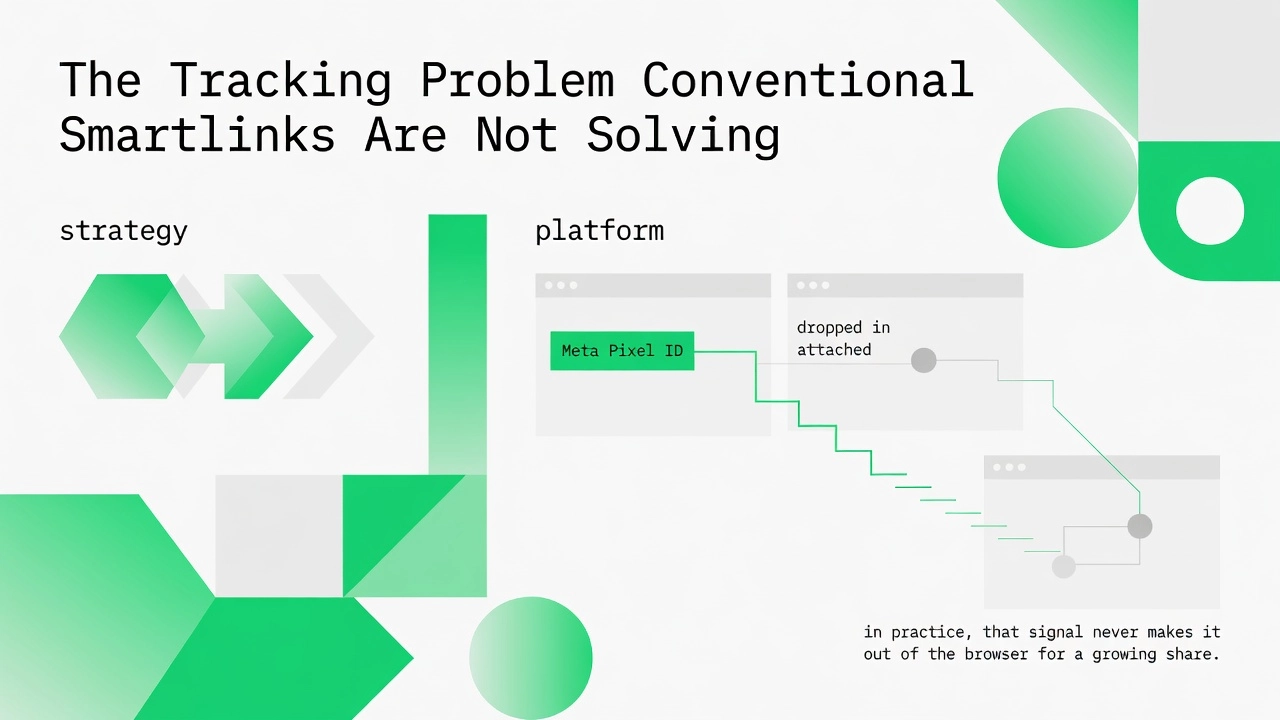
Every conventional smartlink reviewed in 2026 offers some version of pixel support. Drop in a Meta Pixel ID, attach it to the landing page, and in theory every visit feeds your custom audience and optimises your campaign. In practice, that signal never makes it out of the browser for a growing share of the people who matter most to your campaign.
The Adblocker Problem Nobody Talks About
Browser-side pixels are JavaScript tags. When a visitor has an adblocker active, the browser intercepts that script before it executes. The pixel fires into a blocked void. No event is recorded, no signal reaches Meta or TikTok, and the algorithm never learns that a real fan landed on that page, clicked through to Spotify, and engaged with the release. The artist paid for that click. The platform will never know it happened. Industry estimates place active adblocker usage above 40 to 50 percent on desktop and rising on mobile, meaning a substantial portion of every campaign is invisible to the very algorithms being asked to optimise it. The result is not just missing data; it is systematically under-reported performance that makes good campaigns look mediocre and starves the algorithm of the signal it needs to find more fans like the ones who converted.
Bot Traffic Is Quietly Poisoning Your Retargeting Pools
The second silent problem is non-human traffic. Bots visit smartlink pages, register as clicks in the analytics dashboard, and contribute nothing in terms of genuine streaming intent. This matters because the IFPI's 2026 Global Music Report dedicates an entire section to streaming fraud, confirming that fraudulent non-human traffic is an industry-level concern, not a fringe edge case. When an artist builds a custom retargeting audience from "people who visited my smartlink," they are unknowingly seeding that audience with bot profiles. The ad platform then spends budget re-reaching ghost profiles, lookalike quality degrades, and cost-per-result climbs without any obvious explanation. The analytics dashboard shows healthy click numbers; the campaign quietly fails.
iOS 14 Compounded Everything
Adblockers and bots were already eroding measurement before Apple's App Tracking Transparency framework arrived. iOS 14 stripped browser-side signal from the majority of iPhone users by requiring explicit opt-in to cross-app tracking, a permission most users decline. The compounding effect on music campaigns has been severe. Practitioners in the music ad community have reported click-to-DSP conversion rates collapsing from 50 to 60 percent down to approximately 5 percent following Meta's subsequent targeting changes, as documented in discussions within Andrew Southworth's music marketing community. A browser pixel cannot recover signal that the operating system blocked before the script ever ran.
The Architecture That Actually Survives This Environment
Meta's Conversion API and TikTok's Events API solve all three problems at once by routing conversion signals directly from the server to the platform, bypassing the browser entirely. Because the signal never touches the visitor's browser, adblockers cannot intercept it, iOS restrictions cannot strip it, and bot events can be filtered before they are ever sent. The enriched data, including hashed identifiers where available, reaches the algorithm with higher fidelity and enables legitimate optimisation and audience construction.
This is precisely the infrastructure that a 2026 review of the major smartlink category confirms no conventional provider has built. Across every major platform reviewed in 2026, not one documents CAPI integration, TikTok Events API support, bot filtering, or adblock bypass in its published feature set. The category optimised for fan routing and landing page aesthetics while leaving the measurement layer architecturally unchanged since before iOS 14. For artists running paid campaigns, that gap between what the dashboard reports and what actually happened is not a minor inconvenience; it is the difference between a campaign the algorithm can learn from and one it cannot.
Feature-by-Feature Comparison: Song.so vs Conventional Providers
The table below maps the axes that matter most for paid music campaigns. Read it as a checklist, not a sales pitch, because one column has genuine gaps worth knowing about before you commit.
Axis | Conventional Providers | Song.so |
|---|---|---|
Tracking method | Browser-side pixel only | Server-side + fingerprinting layer |
Bot filtering | Not available | Included on all paid plans |
Adblock bypass | Not available | Included on all paid plans |
Meta CAPI support | Not confirmed for any provider | Native |
TikTok Events API | Not confirmed for any provider | Native |
EQM score (ViewContent) | Not published | 6.7 |
Spotify pre-save | Third-party simulation | Official native countdown page |
Apple Music / Deezer pre-save | Supported by several providers | Not currently supported |
Real-time per-action attribution | Aggregated, delayed reporting | Event-level, real-time |
Page speed score | Not published | 90+ Google PageSpeed |
Entry paid plan | From roughly $7 to $50/month | €25/month, all features included |
Free tier / trial | Capped free tiers or time-limited data | 30-day unrestricted trial |
GDPR posture | Browser-level consent banners | Server-side, consent-aware; personal data excluded on rejection |
Tracking Architecture and Data Recovery
The single biggest dividing line in this comparison is not price or design quality; it is where conversions are captured. Every conventional provider in the 2026 smartlink market collects data at the browser level, meaning a visitor running an ad blocker or operating under iOS privacy restrictions produces either a degraded signal or no signal at all. Song.so inserts a fingerprinting and server-side layer between the ad click and the destination that captures up to 70 additional parameters per conversion event. The practical result is an average of 30 percent more data reaching Meta and TikTok compared to browser-only setups, and a Meta EQM score of 6.7 for the ViewContent event. For context, EQM measures how closely the data your server sends matches what Meta can independently verify; scores above 6.0 are considered strong for campaign optimization loops. No conventional provider publishes a comparable benchmark, which itself signals how little the category has invested in signal fidelity.
Pre-Save Support: A Genuine Difference and an Honest Gap
Song.so supports Spotify pre-saves through Spotify's own native countdown pages rather than a third-party overlay that mimics the action outside Spotify's infrastructure. Native countdown pages carry stronger intent signals and convert at higher rates because the fan stays inside the Spotify ecosystem. That said, artists whose audience is concentrated on Apple Music or Deezer should note clearly that song.so does not currently support pre-saves for those platforms. Several conventional providers do cover all three, so if multi-platform pre-save coverage is non-negotiable for a release campaign, that gap needs to be weighed honestly against the tracking advantages elsewhere in this comparison.
Pricing and Feature Access
The conventional tier structure follows a familiar pattern: basic analytics are cheap or free, but the features that actually matter for paid campaigns, such as additional pixels, extended data retention, or custom domains, are gated behind higher tiers. Reviewing the full market confirms that entry plans from several providers either restrict pixel count to one, cap analytics at a few hundred visits per month, or expire data after seven days. Song.so's entry paid plan at €25 per month includes every feature without exception: adblock bypass, bot detection, server-side tracking, CAPI, TikTok Events API integration, and custom subdomains available on request. There is no feature ladder to climb; the infrastructure that makes campaigns measurable is present from the first billing cycle.
Free Trial and Getting Started
Song.so does not offer a permanent free tier, but the 30-day trial is fully unrestricted: no cap on the number of artists, smartlinks, or pixels you can create during that period. Creating a new smartlink requires only a Spotify track or playlist URL, which means the onboarding process for a technically average artist takes minutes rather than hours. Conventional free tiers tend to impose structural limits that make meaningful campaign testing impossible: a seven-day data window is too short to assess a release campaign, and a single pixel slot prevents multi-platform retargeting from the start. On GDPR, song.so's server-side architecture is consent-aware; if a visitor declines tracking via the privacy banner, the conversion itself is still logged, but personal identifiers such as IP address and user agent are not transmitted. That posture is materially more defensible for EU campaigns than a browser pixel that either fires or does not based on whether the visitor accepts cookies.
Why Conversion Signal Quality Directly Changes Your CPM
Meta's ad delivery system does not treat all campaigns equally. At its core, the Andromeda ranking model functions as a continuous auction where the currency is not just budget; it is signal quality. When your campaign sends enriched, accurate conversion data, the algorithm gains the confidence it needs to identify real fans, expand delivery toward similar audiences, and offer you cheaper impressions in return. When your signals arrive degraded, fragmented, or polluted with bot traffic, the algorithm optimizes toward noise. It cannot tell the difference between a genuine save and an accidental tap, so it goes looking for more accidental tappers. The result is a campaign that spends the same budget, reaches the wrong people, and pays progressively more for the privilege.
The Event Match Quality Score That Changes Your Auction Position
The mechanism linking signal quality to CPM is made visible through Meta's Event Match Quality score, a 0 to 10 rating that measures how effectively the data arriving via the Conversion API matches to actual Meta user accounts. High-priority parameters include hashed email addresses and Click IDs; medium-priority parameters extend to phone number, location, and external identifiers. The Meta Business Help Center's own documentation on EMQ confirms that higher match rates directly improve the algorithm's ability to attribute conversions accurately and optimize delivery. Song.so achieves an EMQ score of 6.7 for the ViewContent event, which sits well above what most campaigns running browser-only pixel tracking can produce. To put that in concrete terms: a documented case study from practitioners showed that moving EMQ from 8.6 to 9.3 delivered an 18 percent reduction in cost per acquisition and a 22 percent improvement in return on ad spend. The directional principle applies at every point on the scale; a score of 6.7 represents the kind of enriched, deduplicated signal that gives Andromeda the confidence to expand reach efficiently rather than throttling delivery during an extended learning phase.
The 30 Percent Signal Gap Is a Compounding Tax on Every Euro You Spend
The financial logic of signal loss is not intuitive until you model it as a compounding problem rather than a flat inefficiency. Analysis of over 2,400 music campaigns found that advertisers adding server-side CAPI on top of browser-pixel tracking attributed roughly 30 percent more conversions and reduced learning-phase cost per result by 15 to 25 percent. That 30 percent gap is not simply missing data in a dashboard column. Every conversion event your campaign fails to capture is a data point the algorithm never learns from. The model that determines who sees your next impression was built on incomplete information, so every subsequent impression it purchases is less likely to reach a verified fan. The waste compounds across the entire campaign, not just at the moment of loss.
Why Small Budgets Feel Signal Loss Hardest
The proportionality argument matters more than most artists realize. For a label running a five-thousand-euro campaign, absorbing 30 percent signal loss and fifteen percent low-quality traffic is painful but survivable across a learning phase of several days. Meta's algorithm requires approximately 50 optimization events per week before it can exit the learning phase and begin delivering with confidence. A 30 percent signal loss on a fifty-euro campaign may mean the algorithm never receives enough clean events to exit that phase at all. It burns the entire budget in a semi-blind state, learning from whatever fragmented signals happened to make it through. The independent artist running that fifty-euro campaign is not experiencing a scaled-down version of the label's problem; they are experiencing a categorically different outcome where the algorithm simply never gets the information it needs.
The Practical Loop That Recovers the Budget
Song.so's 98 percent conversion recovery rate, achieved through adblock bypass, bot filtering, and server-side enrichment, closes this loop at the source. Clean signals reach the platform; Andromeda treats the campaign as trustworthy; delivery expands toward audiences that look like verified listeners; CPMs fall because the algorithm is no longer penalizing a campaign it has low confidence in. The artist reaches more genuine fans without increasing spend, and critically, the playlist-save and stream signals that feed Spotify's own recommendation engine also arrive from higher-quality listeners. Song.so's architecture sits between the ad and the destination, filtering bad traffic before it ever fires a conversion event, so the algorithm trains exclusively on people who engaged with intent.
What Song.so Has That No Conventional Smartlink Has Built
The five capabilities covered below do not appear in any conventional smartlink feature matrix reviewed in 2026. They are not incremental improvements on existing tools; they represent different product categories operating under the same roof.
Server-Side Enrichment with Fingerprinting Technology
Where conventional smartlinks fire a browser-side pixel and hope the signal arrives intact, song.so runs a server-side enrichment layer that captures parameters the browser pixel cannot see. Fingerprinting technology matches those server-side signals to Meta and TikTok ad identifiers without depending on cookie state, then transmits the enriched data directly via Meta's Conversions API and TikTok Events API. The practical result is 98 percent conversion accuracy under conditions where browser pixels fail silently: active adblockers, iOS privacy restrictions, and Safari's Intelligent Tracking Prevention. Song.so's Event Quality Match Score on Meta sits at 6.7 for the ViewContent event, a benchmark most smartlink setups cannot approach because their signals arrive incomplete or not at all. For any artist running paid campaigns on Meta or TikTok, optimising against 30 to 40 percent of actual conversions means the algorithm is building audiences from a minority of real signals. The server-side layer closes that gap and delivers, on average, 30 percent more data points per campaign than standard CAPI implementations alone.
Tour Links with City-Level URL Parameters
Song.so's Tour Links fetch ticket availability data automatically from the web and surface status labels such as "low availability" and "sold out" in real time. Price display is optional, toggled per campaign depending on whether showing a ticket cost at the ad stage helps or hurts conversion intent. The standout mechanism is the ?city=Berlin URL parameter: when an artist runs a city-targeted paid social ad, appending the city parameter to the destination URL causes that city's show date to appear at the top of the page on load, removing the scroll friction of a full tour list. No conventional smartlink provider reviewed in 2026 offers native tour or ticketing links with live availability statuses, dynamic pricing display, or geo-contextual URL parameters. For live promotion specifically, this is a conversion-rate tool dressed as a formatting feature.
Bio Link with Integrated Email Newsletter Infrastructure
There is an important distinction between email capture and email newsletter infrastructure. Capturing an address produces a data asset. Sending campaigns to it produces a communication channel. Song.so's Bio Link incorporates YouTube video embeds, a seamless email opt-in flow, and a built-in email newsletter tool that allows artists to compose and send directly to the list they build from campaign traffic. A single stream visit can become a fan relationship that exists entirely outside any platform algorithm. The YouTube embed keeps visitors engaged on the page rather than routing them away, which increases the probability of an opt-in before the session ends.
Spotify Native Countdown Pre-Save Pages
Song.so delivers pre-save pages through Spotify's own native infrastructure rather than through a third-party OAuth flow hosted on the smartlink provider's domain. The difference is trust. When a fan lands on a Spotify-native countdown page, the interface, branding, and authorisation prompt carry Spotify's own visual conventions. A fan granting save permissions to an unfamiliar third-party URL faces a higher psychological barrier than one confirming a save within an experience that looks and feels like Spotify itself. That friction reduction at the authorisation step directly affects pre-save conversion rates for release campaigns.
Fan CRM and Chrome Extension Analytics Overlay
Two final features occupy territory that no conventional smartlink provider has entered at all, as confirmed across the 7 best free music smart links comparison for 2026 and the Feature.fm smart link documentation. Song.so's Fan CRM quietly aggregates contactable fan profiles from paid campaign traffic, building a roster of verified real people rather than a count of anonymous clicks. The Chrome extension sits over Ads Manager and Spotify for Artists simultaneously, translating raw platform numbers into readable campaign narratives inside the interfaces artists are already using to make decisions. Neither product requires logging into a separate dashboard. Together, they represent the closest thing the independent music market currently has to a closed-loop paid promotion system: traffic enters, conversions are captured accurately, fans become contacts, and performance data surfaces at the exact moment an artist needs to act on it.
GDPR Compliance, Page Speed, and Getting Started in Seconds
Privacy by Consent, Not by Assumption
No published audit of any major US-based smartlink provider exists that documents how the tool behaves at the per-consent-state level. That gap matters in practical terms. Under GDPR Articles 4 and 6, an IP address qualifies as personal data and requires a lawful basis for processing. A tool that fires its tracking scripts on page load regardless of what the visitor selects on a consent banner is not technically compliant, regardless of what its terms of service claim. Song.so handles this at the architectural level: when a user declines tracking on the privacy banner, only the conversion event itself is recorded. No IP address is stored. No user agent string is retained. The personal data simply is not collected. For European artists, labels running EU ad campaigns, and agencies carrying GDPR accountability obligations on behalf of clients, this is not a minor checkbox item. It is the difference between a tool that can be deployed with confidence across the EU and one that creates quiet legal exposure every time a German or French fan clicks through from a Meta ad.
Pages That Load Before Fans Give Up
Song.so holds a Google PageSpeed score above 90, a benchmark worth contextualising against the category problem it solves. Conventional smartlink pages frequently load heavy JavaScript payloads, embedding ad pixels, analytics scripts, and interactive player widgets before a single DSP button becomes clickable. On a strong urban broadband connection, the delay is negligible. On a 3G mobile connection in Lagos, Nairobi, or Jakarta, that same delay can push load time beyond three seconds, the threshold at which mobile bounce rates consistently exceed 50 percent in Google's own Core Web Vitals research. The bedroom artist sending a small Meta budget toward a new single and expecting fans in emerging markets to actually reach Spotify is, in practice, paying for page abandonment that never registers in any analytics dashboard. A 90+ PageSpeed score eliminates that invisible leak. No competitor PageSpeed scores appear anywhere in published 2026 smartlink comparisons; readers who want to benchmark this independently can run any smartlink landing page through Google's PageSpeed Insights tool and compare the numbers directly.
From Spotify URL to Live Link in Under a Minute
Creating a smartlink on song.so requires one action: paste a Spotify track URL or Spotify playlist URL. The link generates immediately. There is no campaign configuration screen, no platform-by-platform toggle setup, and no onboarding sequence to complete before the link functions. This matters because a recurring critique of more established tools is that beginners lose time in settings menus before a working link exists. For an independent artist managing a release, content calendar, distributor deadlines, and an ad campaign simultaneously, setup friction is not an inconvenience; it is the reason campaign infrastructure gets abandoned mid-launch and ads go live pointing at a direct Spotify URL with no tracking attached at all.
No Caps, No Forced Upgrades, Branded Links From the First Paid Plan
Every paid plan on song.so includes unlimited artists, unlimited smartlinks, and unlimited pixels. For an agency managing twenty client campaigns concurrently, or a label dropping singles weekly across multiple projects, per-artist or per-link caps create upgrade pressure that is entirely disconnected from value delivered. The category default is to gate volume or functional depth at ascending price tiers, a structure that penalises exactly the users who are most actively running campaigns.
Custom subdomains extend this logic to branding. Any paid plan from 25 euros per month can receive a custom subdomain on request, structured as label.song.so/track. Enterprise pricing is not required. A boutique label with three active artists gets the same branded link experience that the category's dominant tools reserve for major-label contracts, without needing a procurement conversation to unlock it.
When a Conventional Smartlink Might Still Be Enough
Not every artist needs server-side tracking, and saying otherwise would be dishonest. There are real scenarios where a conventional smartlink is the appropriate tool for the job, and recognising those boundaries is more useful than overselling a solution past its actual use case.
When Organic Is Your Only Channel
If your release strategy relies entirely on organic social sharing, playlist pitching, and editorial coverage with zero paid spend behind it, the gap between browser-side and server-side tracking carries almost no practical consequence. The reason server-side conversion tracking matters is that it feeds a paid platform algorithm with cleaner signals, which in turn affects delivery costs and audience targeting. Remove the paid campaign from the equation entirely, and that feedback loop simply does not exist. An artist sharing links through Instagram Stories, TikTok organic posts, or a newsletter is not asking Meta or TikTok to optimise ad delivery. A simple click-tracking smartlink that shows platform preference data and geographic reach is genuinely sufficient for that use case.
When Budget Is Zero and Pre-Saves Are the Goal
For artists on a zero budget who need to run a pre-save campaign ahead of a release, some conventional providers offer free unlimited pre-saves with no monthly fee attached. This is a legitimate and practical option for an indie artist who has no advertising budget and simply wants to build early Spotify momentum before a drop. The tracking architecture behind that pre-save page is less relevant when no ad spend is flowing through it. Organic pre-save links shared through a fan community, a Discord server, or a social bio serve a straightforward purpose and a free tool handles it without friction.
When the Job Is Catalogue, Not Campaign
Large label operations managing hundreds of catalogue releases often need a different tool profile than a campaign-first advertiser does. The primary requirement becomes organisation, editorial presentation, and consistent link formatting across a deep back catalogue rather than per-campaign conversion optimisation. Some conventional providers are structured around exactly this need, offering hierarchical link management and editorial features suited to high-volume catalogue work. That is a different product category than a tool built for a single artist spending a focused budget on one release.
The Honest Summary
The gap between a conventional smartlink and a server-side conversion tracking platform is smallest when paid advertising is entirely absent, and grows into a categorically different problem the moment real budget enters the picture. For anyone running even a modest paid campaign on Meta or TikTok, the structural difference is not a minor upgrade. Browser-side pixels miss conversions behind adblockers, lose attribution after iOS consent prompts, and send incomplete signals that cause the algorithm to misread your audience. Understanding smart links as a traffic optimisation layer clarifies why the underlying tracking architecture matters more than the landing page design itself. When every euro spent is actively competing in an auction where signal quality determines both cost and reach, the tool doing the tracking is not a commodity choice. It is the variable that decides whether the algorithm rewards your campaign or throttles it.
Two Different Tools for Two Different Jobs
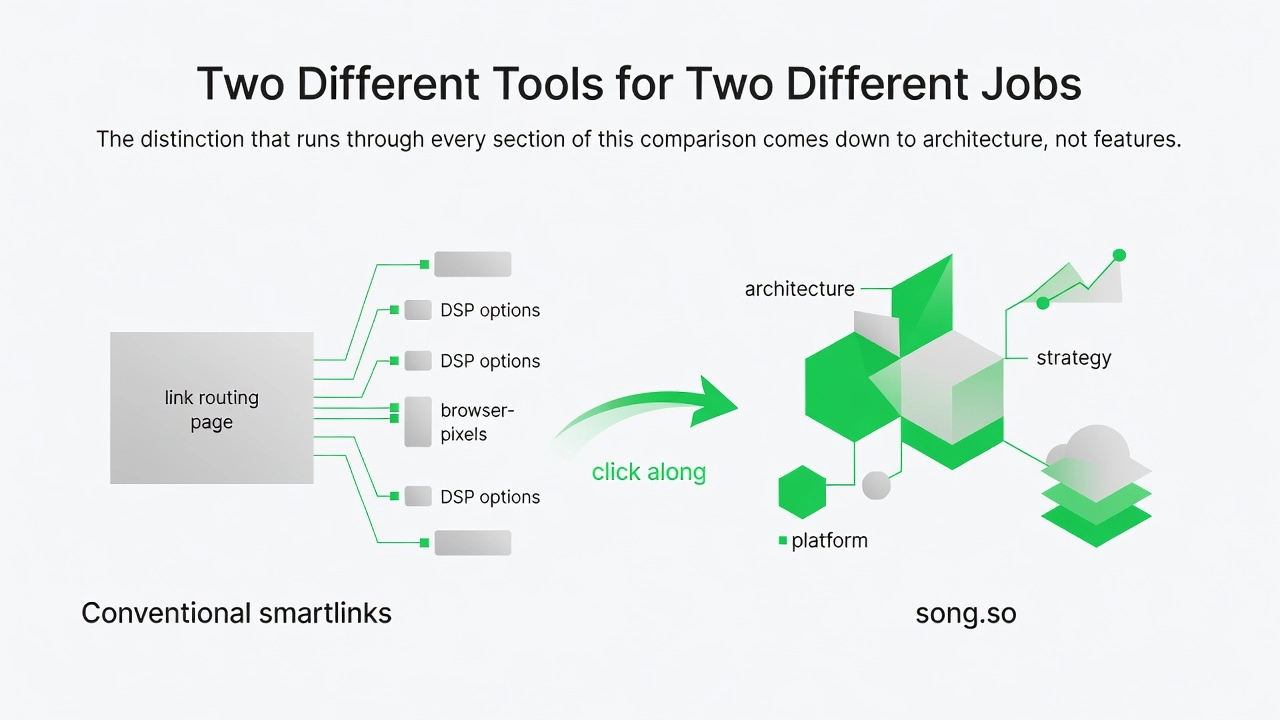
The distinction that runs through every section of this comparison comes down to architecture, not features. Conventional smartlinks are link routing pages with browser-side pixels attached. They present DSP options, fire a tracking event when someone arrives, and pass the click along. song.so is a conversion-tracking platform with a server-side enrichment layer, bot filtering, and adblock bypass built specifically for paid campaigns on Meta and TikTok. Those are not two versions of the same tool; they are two different products solving two different problems.
If you are spending money on music ads, that architectural difference shows up in your results whether you are aware of it or not. Your smartlink provider is either feeding your algorithm clean, enriched, verified conversion signals, or it is starving it of the data it needs to find real fans. That choice reflects directly in your CPMs, your learning phase duration, and ultimately your reach. Better signal means the algorithm rewards your campaign with cheaper, more targeted delivery. Degraded signal means you pay more to reach people who are less likely to care.
The lowest-friction way to measure that gap firsthand is song.so's 30-day unrestricted free trial. Run a real campaign, compare the data quality, and let the Event Match Quality scores tell the story.
The post-iOS, post-Andromeda era does not have to be a survival puzzle. But it requires infrastructure that was actually built for it.
Conclusion
Choosing the right smartlink platform can genuinely change how your music performs after release. Song.so stands apart through its deep customization options, precise data tracking, seamless distribution integrations, and a listener experience designed to convert casual clicks into loyal fans. These are not minor upgrades; they are the building blocks of a smarter release strategy.
If you are serious about your music career, settling for a basic link-in-bio tool means leaving real opportunities on the table. Song.so gives artists the control and clarity they need to make informed decisions about their promotion.
Ready to see the difference for yourself? Create your first Song.so smartlink today and experience what a purpose-built music platform can do for your next release. Your music deserves more than a generic link. Give it the landing page it was made for.